The trip to Bangkok went smoothly Sunday morning. I was able to visit the post office in the airport and send some postcards and a small box full of things I decided I didn’t need back to the U.S. I shipped the box to my cousin for safe-keeping (thanks Valerie!) until I get back to the US for only 1,450 baht (about 40 USD). My backpack feels so much lighter already, and now I won’t feel guilty about buying things! 🙂
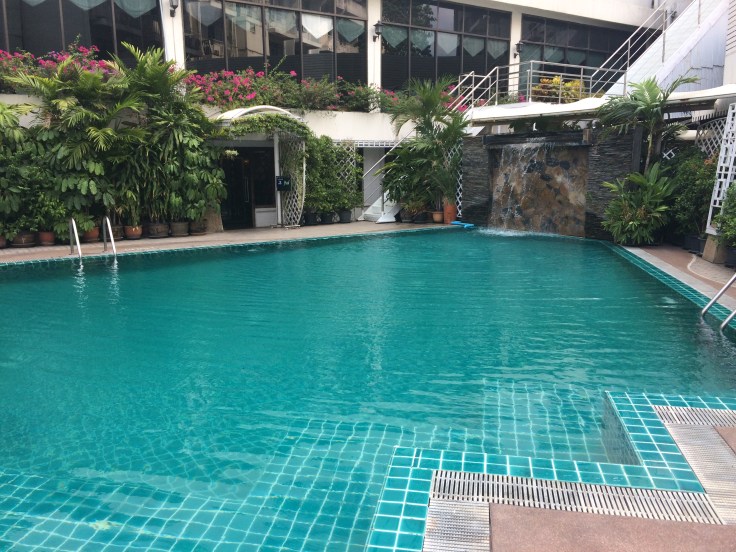
Once in Bangkok, I took a car to my hotel (arranged through the group I am traveling with, G Adventures) and checked in. I was very excited to see the hotel was pretty nice…although I’d only stayed in a hostel 3 nights in Chiang Mai, I realized how much I like having space and privacy! I will be in hotels for the rest of SE Asia, and then will be in hostels the rest of the summer, I am now thinking I may have to treat myself to a hotel every now and then later in the summer as the budget allows! Instead of sightseeing, I decided to relax by the pool for the afternoon, which was an excellent decision.
Around 6pm, Alexa (roommate from Germany, also traveling solo!) and I met up with the rest of our travel group, where we met a third solo female traveler (from Australia). The six other people in the group are from Canada and Britain. Just as it was in Africa, I am the only American in our group…evidence that Americans need to travel more! 🙂
After meeting up, we all went to dinner and then took tuk-tuks to Khaosan Road. This is where it got interesting! Khaosan Road is ridiculous! It is like the Thai version of Bourbon Street in New Orleans or Beale Street in Memphis. Perhaps it was a little touristy and over the top, but I absolutely loved it. After a lot of dancing, people-watching and experimenting with food (Alexa and Jemma tried scorpion! I observed…), we headed back to the hotel to get some rest.
In Chiang Mai, people told me I would not like Bangkok because it was dirty, hot, and too busy. Ironically, these are exactly the reasons I liked it so much! It’s definitely on the gritty side, like NYC :-), but I really enjoyed it. I do feel a little guilty for chosing the pool over seeing temples or the Grand Palace, but I will just have to catch those next time. 🙂 This morning, we drove from Bangkok to cross the border into Cambodia at Poipet. While walking the 10 minute stretch across the border, it immediately struck me how much poorer Cambodia is than Thailand. Thailand is very developed and luxurious compared to Cambodia. I also learned that no education is free in Cambodia–not even primary school. (In Thailand, primary school is free but nothing else.) I have only been here for an hour and am already floored by what I am seeing and learning.
On the way to Siem Reap, we stopped at a roadside restaurant and I had my first Cambodian meal–fish amok with an Angkor beer. Very on point and so delicious! Tomorrow, it’s on to Angkor Wat!
Chiang Mai has been a perfect start to the trip! After going to dinner and out with some very new friends on Thursday night, I woke up at 6am on Friday (thanks jetlag!) to plan my next 2 days in Chiang Mai. Fortunately, my hostel had a full-time travel agent on staff who was able to help me plan some fun things.
I spent Friday morning exploring the area. After shopping for a bit and trying to talk myself out of buying items to add to my already heavy backpack, I wandered past Wat Bupparam on Tha Pae Road (a wat is a temple!). I walked through the gates to check it out, and noticed a monk doing his chants in a small side temple on the complex. I took my shoes off and stood outside, not wanting to interrupt but curious all the same. He looked up from his pages, smiled, and waved me in. I sat with him as he finished his chants. I couldn’t help but feel very humbled as I sat with him–just the 2 of us in the temple. I was not planning to take a picture, as I assumed this would be disrespectful. However, after he finished his chant, he gestured for me to take a picture. I asked/gestured to see if he was sure this was ok, and he smiled and nodded his head. So here’s my monk friend…I am so grateful that he made me feel so welcome, even though I was clearly very awkward and lost!
My new friend 🙂
After more wandering around, I then spent the afternoon at the Elephant Jungle Sanctuary (you can read about that here).
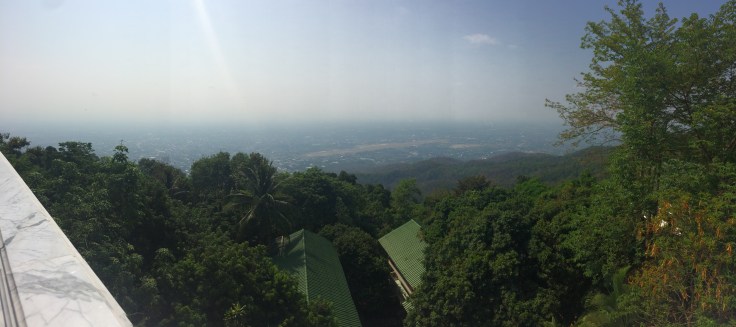
Saturday morning, I headed to Wat Phra That Doi Suthep with one of my Canadian friends from Thursday. The trip to the wat took about 30 minutes in a songthaew (a taxi where you sit in the back of a pick-up truck!) and the ride was a very steep uphill climb. Once there, we trekked 300 steps to reach the wat, removed our shoes and explored the temple. It had an amazing view of Chiang Mai!
The sassy monk statue on the right is throwing shade!View of Chiang Mai from Wat Doi Suthep
After visiting Wat Phra That Doi Suthep, we took a cruise of the Ping River to a small farm down the river. The other two people in our boat happened to be Bible translators. I learned that over 1,500 of the 6,000 spoken languages in the world have no written form.Their work is to visit remote villages in areas of the world where there is no written alphabet and work with the people there to use an international phonetic alphabet to create a written language. They then translate the Bible, as well as information regarding best agricultural practices and healthcare that can be helpful to the community. At the farm, we visited the various crops and had a delicious lunch of lemongrass juice, longan juice, tamarind juice, and fruit before cruising back to Chiang Mai.
The cruise passed the summer home of the princess of Thailand!
Above: U.S embassy in Thailand, black chickens, and a man fishing
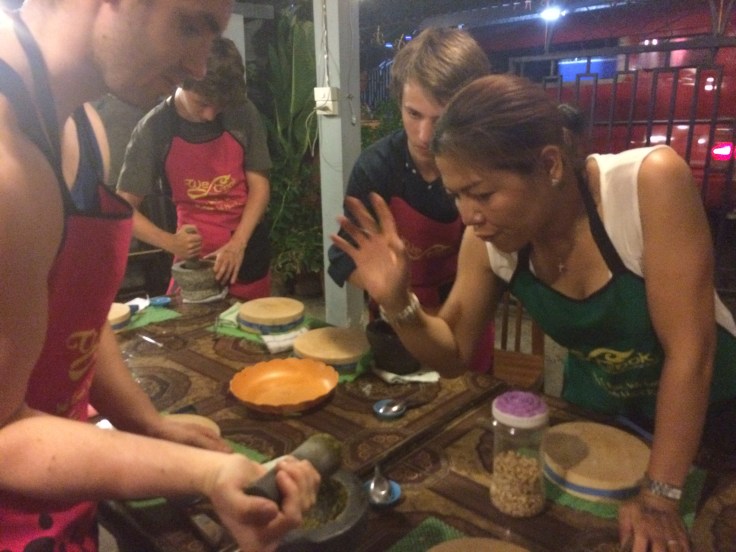
After relaxing back at the pool at the hostel for a bit, I went to a cooking class with Mam at We Cook. After visiting an open air market to buy ingredients, we headed back to Mam’s house, where she taught us all about Thai cooking. Mam is absolutely fabulous…I learned a lot about strong flavor groups and balancing sweet, salty, hot, and mild flavors. The class was full of several other solo travelers, and by the end of the 5 hour class, we were all good friends after laughing at each other for 5 hours. I made spring rolls, green curry, tom yam soup, pad thai, and sticky rice with mango. Yum yum!
Crushing spices for green curry. It’s hard work!Mam checking our work. She demanded excellence!
Tomorrow, I say goodbye to Chiang Mai. It is such a special place, and I’m happy it was my very first stop for the summer!
This afternoon, I hopped in the back of a pickup truck with a few other friends from my hostel and rode 1.5 hours through the hills outside of Chiang Mai to visit the Elephant Jungle Sanctuary. The sanctuary is a camp for elephants who were formerly used in the riding business. Many people aren’t aware that riding elephants actually hurts the elephants over time, as their bodies are structured to carry weight in their lower bodies and not on top. Elephants are also harmed by the equipment used in the riding business, such as straps and hooks. The average lifespan of an elephant used for riding is about 20 years shorter than other elephants.
The sanctuary, as well as camps and parks with a similar focus, is harnessing the tourism industry to change the way elephants are perceived and treated. Elephants were once used by their owners in the logging industry. When that industry dwindled, elephants were then transitioned into the tourism industry as a riding attraction. The elephants are owned by “mahouts,” or elephant trainers, who train the elephants to do tricks and to be ridden and then lease the elephants to tourism companies. By introducing a sanctuary experience as an “ethical alternative” that consistently attracts consumers, the sanctuary pitches itself to the mahouts as a better (the mahouts don’t want the elephants to suffer either, but they have to find ways to cash in on their investment), more lucrative, and more promising business choice for their lease. The sanctuary then attracts tourists to come and feed, bathe, pet, and rinse the elephants, and uses the money made to pay the mahouts as well as operational costs. Mahouts make money, the elephants are treated well, and tourists can take part in a fun experience. The sanctuary will also buy riding elephants with its own funds, and these elephants become permanent residents of the camp. All other elephants are on lease from their mahouts.
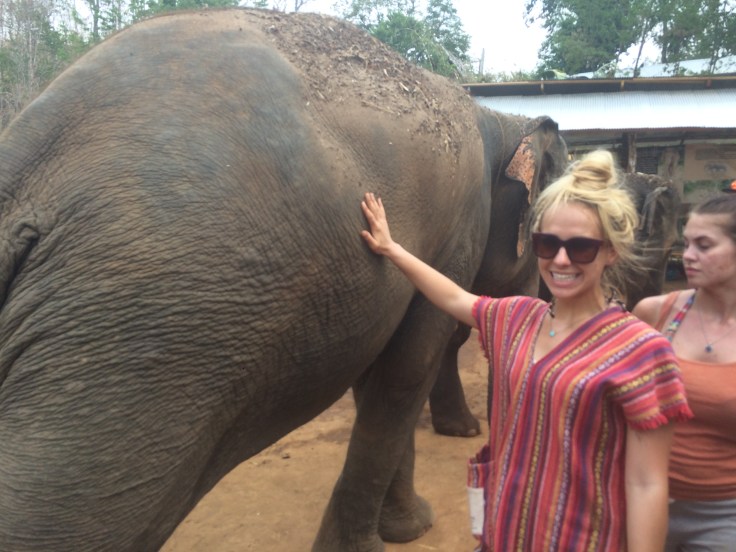
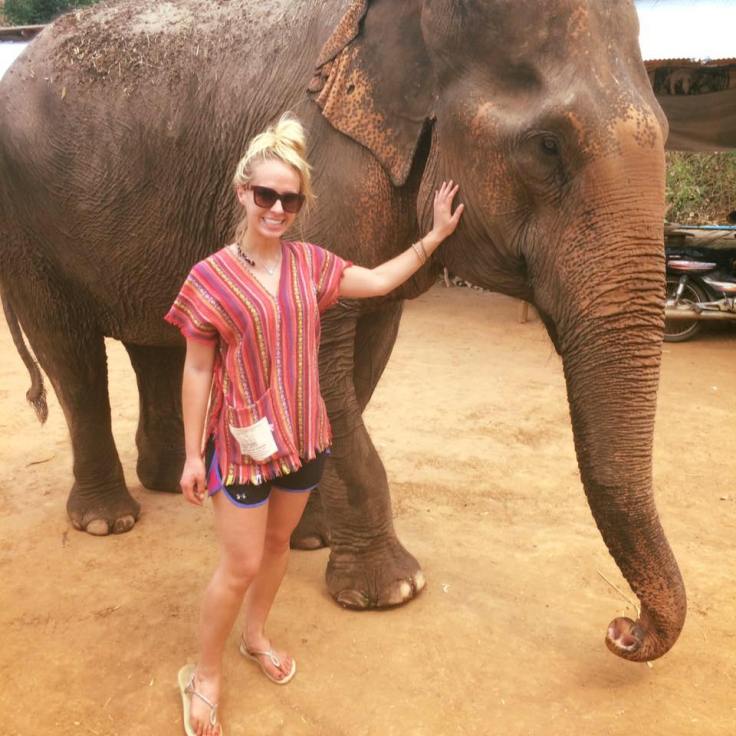
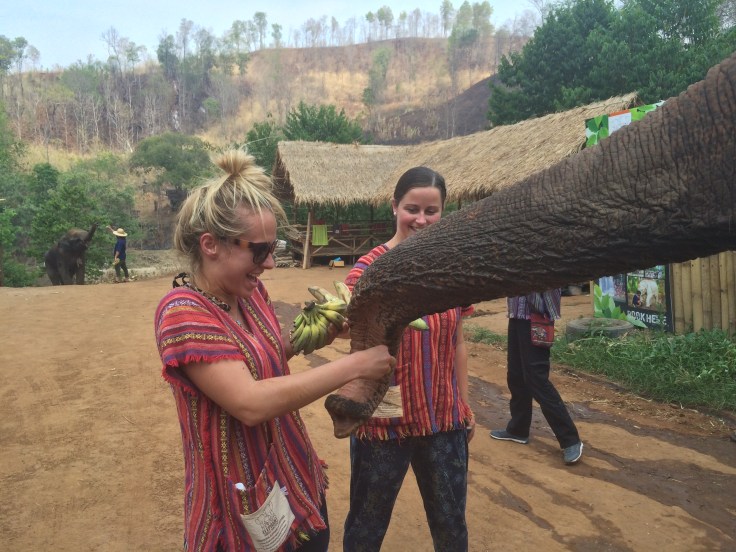
So what did we do with the elephants? First, we had to put on a traditional Karen tribal tunic. The guides told us this is so the elephants would feel comfortable around us (maybe this is true, or maybe it’s something they just tell tourists…who knows!) Then, we started feeding the elephants bananas. Elephants eat between 200 and 300 kilograms of food per day! The elephants were not shy at all, and actually followed us when they saw we had bananas in our hands! One elephant even almost mistook my iPhone in my hand as a banana…crisis averted! These elephants were very muddy, and it didn’t take long before I was very muddy.
The elephants are so excited to get bananas from visitors!!
This was very fitting, as we next took the elephants to a mud pool and got in the pool with them to give a mud bath. Yes, I swam in the mud with the elephants! I have never been dirtier in my life, and it was fabulous! My biggest concern was being careful that the elephants didn’t accidentally step on me or one of my friends. We were a few hours from any town, so this would be a bad place to break a foot! After the mud bath, we followed the elephants down to a river and rinsed and scrubbed them. Then, we left the elephants behind and trekked to a beautiful waterfall in the jungle and went for a swim. By this point, I was covered in mud from head to toe, so I took the chance to rinse off in the surprisingly cold water. Afterward, we all had a delicious meal prepared by the camp workers, and then hopped on the back of the pickup to go the 1.5 hours back to Chiang Mai. Given the winding and bumpy road and exhaust fumes from the truck, we were all a little nauseated, but that was a small price to pay for such a beautiful and magical day!
This elephant is pregnant and you could feel the baby elephant kicking!! Her baby will get to live at the sanctuary with her 🙂
I’ve finally arrived to my first overseas destination in Northern Thailand! I will be spending a few days here solo before heading to Bangkok on Sunday to meet up with a group. I arrived after layovers in Chicago, Vancouver, and Shanghai, for a total of 35 hours of travel time. Yes, Memphis → Chicago→ Vancouver→ Shanghai→ Chiang Mai. Crazy, but I did it!
Surprisingly, the Memphis airport was the busiest I have ever seen it on Tuesday afternoon. It usually takes less than 15 minutes to check in and get through security. It took about 45 minutes on Tuesday. Fortunately, I made it to my gate just fine with about 10 minutes to spare. My dad saw me off at the airport. I am so glad I was able to spend time with him this week, as well as with my mom, other family members, and friends over the last few weeks before the leaving the U.S.–it meant so much to me!
Once I arrived in Vancouver, I realized quickly that the Canadian version of TSA is so strict! Even though all of my shampoos and conditioners were in small bottles, they said I had too many bottles, so I had to throw some away. I didn’t want to be “that girl,” but I really wanted to explain to him how picky I am about my hair products, and I needed to take all of these with me to last for 3 months! However, I kept my mouth shut and sadly threw several away in order to be in compliance. I was annoyed then, but now I realize it’s pretty hilarious I had so many tiny bottles in my backpack. Also, my backpack is a little lighter now!
In Vancouver, I boarded a 12 hour flight with China Eastern to Shanghai. Unfortunately, I had looked up China Eastern on Yelp the night before, and was thoroughly freaked out by what I read. It seemed all of the reviews talked about how horrible the airline was, regarding everything from the manners of the crew to leg space to food to safety. One reviewer even talked about how his flight had been in freefall multiple times, and he thought he was going to die as he and the other passengers screamed the whole flight! Needless to say, this made me even more nervous.
However, the flight could not have been smoother. We flew over Alaska, the Bering Strait, and Russia, barely crossing the Pacific (This was important to me, as I get nervous about flying over large bodies of water. If you have to emergency land, where do you go?!) We even flew around the edge of North Korea (!) and landed in Shanghai ahead of schedule. The layover in Shanghai airport was very relaxing, as I accessed the free wifi to text and FaceTime with friends and family and found a Starbucks for a “just like home” coffee fix! The only downside is that I was unable to check both my Gmail and Facebook, as the Chinese government has blocked both. I also wasn’t able to use Google for the same reason. I’ll never take these sites for granted again!
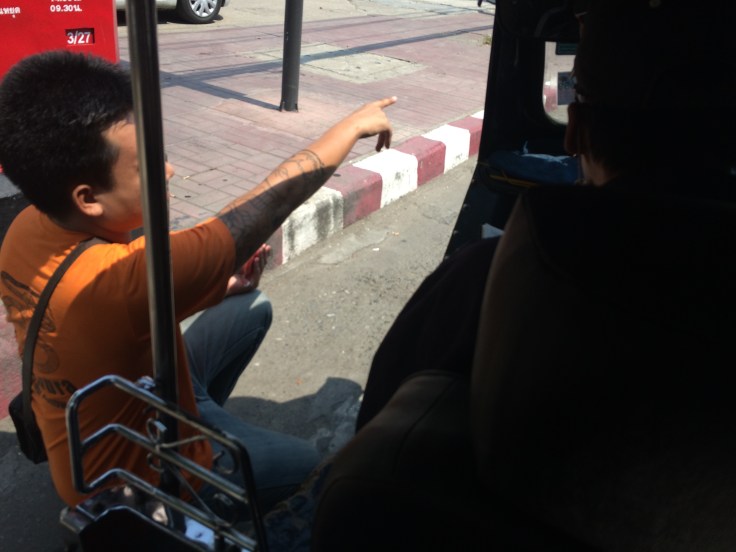
Once I finally arrived in Chiang Mai, I hired a tuk-tuk (basically a motorcycle taxi) outside of the airport to take me to my hostel. I was able to bargain with him to reduce the price from 200 baht to 160 baht! He swore he knew where my hostel was, but it was only after 45 minutes of riding around and stopping to ask 6 people that we ultimately found it. I am not complaining though…the ride was fun and I was able to get a good first look around Chiang Mai! The first night in Thailand was a complete whirlwind, mostly due to extreme tiredness and adrenaline. I made friends with a group of Canadians at my hostel, and we went to dinner and then to a “disco” (just a bar really…but it’s fun to call it a disco!) I’m excited to see what the next few days in Chiang Mai hold!!
Tuk-tuk selfie (no shame!) Delirious and excited after 35 hours of travel!Asking directions (again). I didn’t think we would ever get there…everyone was extremely nice and tried to be very helpful though!
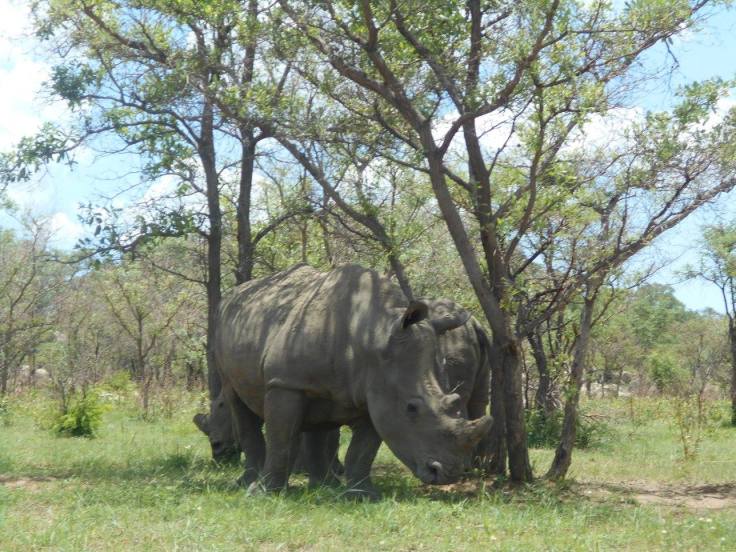
If there is such thing as a modern day dinosaur, the rhino comes close. It was like stepping back in time, as I watched these majestically ancient creatures move purposefully under the shade provided by the trees’ small branches. I found myself in awe of their presence. I tried not to breathe very loudly, as the rhino fixed his beady eye on me. If he wanted, the rhino could have plowed through the shade trees, easily uprooting them, before making his way to and through myself and my fellow travelers crouched low in the grass just a few yards away. However, the peaceful and friendly nature of these rhinos put me at ease, and I knew they were content to have me in their backyard, so long as I didn’t make too much noise! I fell in love with these easygoing creatures.
The issue is we are losing these animals.
One of the most magical but least expected highlights of my trip to Africa in December was the day I spent tracking the white rhinoceros near the Matopos with Ian Harmer of African Wanderer Safaris. I have always considered myself to have a respectable level of concern regarding animal and wildlife issues. However, spending a day with the rhinos of Zimbabwe made me passionate about the fight to save the rhino from extinction. I was stunned by what I learned—it is estimated two rhinos are killed each day, and poaching has grown considerably in the last 10 years. In 2007, 13 rhinos were poached in South Africa. In 2015, 1,215 rhinos were poached. At this rate, there will be no more rhinos left in the world within the next 10 years, in the wild or in captivity.
Snack time!
Why are the rhinos dying?
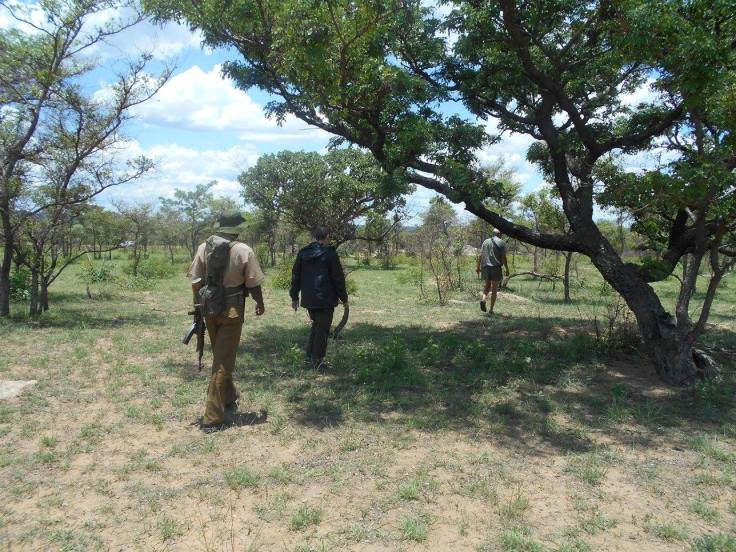
Rhinos across southern Africa are the target of organized poaching schemes driven by the economic forces of the illegal horn trade across Asia. Some Asian cultures believe rhino horn holds special medical power (everything from boosting male virility to curing cancer). The rhino horn can be worth up to twice its weight in gold in these markets. Poachers have advanced systems involving helicopters and infrared technology to track and kill the rhinos, often in the most inhumane ways possible. Ian shared a heartbreaking story from several months back about finding a rhino he had “grown up with” left for dead on the side of the road after the poachers had cut his face off to take his horn. In an effort to protect the rhinos in the fight against the poachers, rangers at the Matobo National Park carry machine guns and are mandated to shoot and kill suspected poachers on the spot.
With an armed guard in the park
Perhaps the biggest tragedy of all is that rhinos do not have to die or suffer to give up their horns. In fact, cutting a rhino horn is similar to clipping a human’s fingernails or toenails—if done correctly, the process is easy and pain-free. The staff at the Matobo National Park regularly cuts the horns of the rhinos in their park, in order to make them less of a target for poachers. This is unlike the elephant’s tusk, which is essentially a tooth instead of a fingernail. Elephants must be killed to extract the tusk.
How can we save the rhino?
The Convention on International Trade in Endangered Species (CITES) has been instrumental in working to protect the rhino and eliminate illegal horn trading. CITES meets every three years and has a standing committee specifically focused on the rhino. Recently, CITES has pushed for the government of Vietnam to conduct “consumer behavior research” in an effort to develop strategies to decrease demand for rhino horn, as well as to impose stiffer penalties for those participating in the illegal market. CITES has also mandated Mozambique, South Africa, and Zimbabwe to continue their efforts to coordinate along their borders to stop poachers, as well as to implement penalties for poachers more consistently. For example, in 2013, Mozambique issued a higher number of poaching fines than ever before, yet only 3% were paid.
The challenge is finding a solution that will prevent the rhinoceros from becoming extinct. It is quite difficult to change mindsets and alter economic pressures over a given period of time, and even more so when the time is severely limited given the rate that rhinos are being poached. What if the trade of the rhino horn became legal? Until 2009, domestic trading of rhino horn was legal in South Africa. It was made illegal in 2009 as a response to the spike in poaching. What about international trade of rhino horn? CITES banned this in 1977, in an effort to protect already dwindling rhino numbers. Despite these bans, the poaching issue has become considerably worse over the last decade, and we are now facing the possible extinction of the rhino.
Since it is painless to cut the horns of rhinos (or “dehorn” them), rhinos could be farmed like cattle and dehorned regularly, thus better protecting them from poachers and generating a profit for the farmers and benefitting the local economy. Also, poachers will be de-incentivized, as a legalized trade would increase supply and lower prices. However, there is always the risk that legalizing the trade could have the opposite effect of increasing demand, in which case poachers would still have inducement to poach. Also, given the demand for rhino horn is primarily in Asia, a ban on domestic trade of rhino horn is a non-issue, as there is really no domestic market. It seems a lift on the international trade ban would be the key driver of this solution.
CITES will have their triennial meeting this September in Johannesburg, South Africa. Without doubt, there will be continued debate on what policies would be most effective for protecting the rhino. I hope the leaders at CITES realize the current strategies have been ineffective, and time is running out for the rhino unless we change the game.
One of the most exciting parts about traveling abroad is the unknown and the unfamiliar—being surrounded by people who don’t speak your language, using money you don’t know the value of, and finding your way around a brand new place where your recognize nothing. To make the unknown more exciting and less distressing, it helps to do a little homework ahead of time. Although it’s impossible to prepare for every “unknown” you will encounter along the way, doing some preparation beforehand will build confidence for the solo or first-time traveler, more than anything. Below are some of my basic tips for preparing to encounter the unfamiliar during a trip abroad.
Learn a few basics of the local language. Several readers have already asked me how I travel solo to countries where English is not spoken. The truth is, most people know some amount of English in most places you may be traveling. However, it helps to learn some language basics of the country you’re traveling to in advance, keeping in mind you will also learn a good bit once you actually arrive (thank you, Joslin, for teaching me “how to flirt” in Afrikaans!)
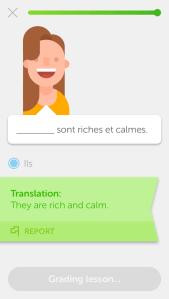
Apparently, Duolingo thinks this phrase will be useful to me during my travels!
For my travels this summer, I have decided to focus most of my preparation on learning French, since I will be spending a relatively large amount of time in and around Paris. From what I’ve heard, the people there are less likely to choose to speak English and expect you to get on their level and speak French primarily! I recommend the Duolingo app for your smartphone (free in the App store). Duolingo will quiz you simultaneously on vocabulary, verb conjugation, and common phrases by using matching exercises, bi-directional translation exercises, and microphone recording. The app will also send you push notifications and emails to remind you to stay regular on your practice. (If you fail to practice regularly, the app will even send a very sad message that says, “We see these notifications aren’t working, so we’re going to stop sending them…” 😦 )
As for the other countries I am visiting, I plan to rely on the very basic skills I still have left from Spanish courses in college, as well as an Eastern European language phrasebook and Southeast Asia dictionary. As a last resort, I also plan to carry this picture dictionary, although I plan to avoid using it at all costs! (I feel like this screams “tourist,” but let’s be real…I am a tourist. And it is best to be prepared!). My goal is to come away from each country with at least a few solid phrases and expressions I can use the rest of my life!
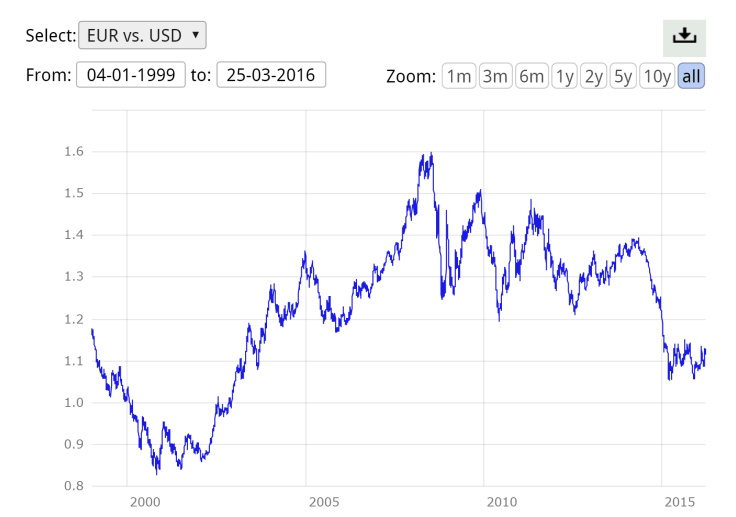
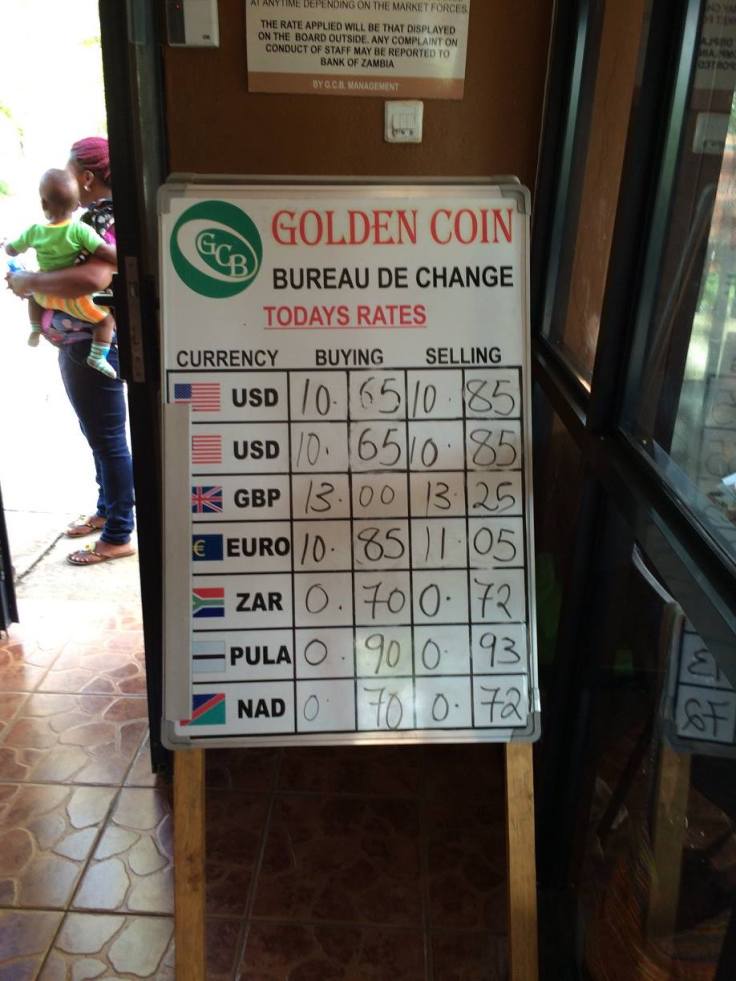
Practice your mental math to calculate currencies. When planning a trip abroad, it’s important to keep an eye on exchange rates. During my time working in foreign exchange, I paid attention to exchange rates down to the pip/half-pip. However, it’s important to only know general “ballpark” rates to be able to calculate exchange rates in your head. Depending on where you are traveling, one of the most important rates you need to learn is the EUR/USD rate. For the last year, EUR/USD has been in the +/- 1.10 range, meaning 1 euro has been worth about 1.10 US dollars. This means Europe is a slightly “more expensive” place to spend money than the US. Despite this value difference, now is a great time for Americans to travel to Europe, as the US dollar is the strongest it has been since being at parity with the Euro in the early 2000s!
EUR vs. USD exchange rate since the inception of the Euro in 1999. Source: ECB
To calculate prices, I know that the cost of something in euros is really that plus around 10% in US dollars (just move the decimal place over once to get 10%), or the price in euros x 1.10. (For example, something that costs me 2 euros really costs me roughly $2.20, something that costs 45 euros really costs me roughly 45 + 4.5, or $49.50, etc.)
It’s not as bad as it seems!
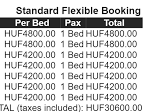
It is important to realize that the Euro is the “base” currency against USD, and the same is true for the British pound, Australian dollar, New Zealand dollar. However, for most currency crosses, the US dollar will be the base currency. This means that when my hostel reservation in Budapest costs me 4,800 Hungarian forints per night, I only owe $17 per night (1 USD is worth approximately 280 HUF, so I divide 4,800 by 280 to get ~$17/night. Very reasonable!)
(Note to my former math students who may be reading this–see how useful math can be!?)
For those of you without an FX background or who would like to simply double-check your currency conversions, I recommend the free Oanda Currency Converter smartphone app. I will be keeping this on my phone, and referencing as needed!
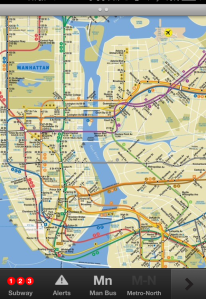
The NYCMate app. Check the app store for similar free apps for any cities you plan to visit!
Use maps on apps! Living in NYC has instilled me with a deep love of and appreciation for public transportation. I have had the NYCMate app on my iPhone since day #1 of living in the city, and I am now seeking out similar apps for cities where I plan to use public transportation a good bit. So far, I’ve been able to find similar apps for the metro systems in Paris, Berlin, London, and Munich. Of course, it’s always good to have old-fashioned paper maps on hand for when/if your smartphone runs out of battery (gasp!). Most hostels provide maps of the city for free.
What do you mean it is 45 degrees?! After riding for 4 hours under the scorching African summer sun and drinking ~2 liters of water to stay hydrated, imagine my surprise when my safari guide told me it was 45 degrees! I knew he was, of course, giving the temperature in Celsius. However, measuring temperature on the Fahrenheit scale my entire life means I need to do an extra calculation in my head when discussing temperatures in every other part of the world (just 5 countries measure temperature in Fahrenheit!)
The equation for the conversion is F= C*1.8 + 32 (Former math students who are still reading–this is your standard y=mx+b equation!)
However, the shortcut is just to multiply the Celsius temperature by 2 to approximate the Fahrenheit temperature.
Until my next post, totsiens! Or goodbye (in Afrikaans)!
“Travel is the one thing you buy that makes you richer.”
I could not agree more with this statement. Travel (along with education) is the most important investment you can make in your personal development.
But, let’s be real. Traveling is expensive. Once you decide to travel abroad, it helps to have a game plan in place to make the trip a reality. You do not have to have a trust fund or win the lottery to see the world! With some research, extra attention to spending habits, and patience, the world will be yours to see. Below are some of the tips and advice I’ve found to be helpful in the process.
Save, save, save!Once you decide upon a trip abroad as a goal, pay yourself to go. What do I mean? Take a close look at your budget (fixed costs v. discretionary spending). What can you live without? It is really as simple as deciding you can live without certain things, and setting the money you would otherwise spend aside. For example, as soon as I got back from Africa, I was so inspired to save money to travel more that I cut off my cable!
There was no cable available in my tent in Africa, and I found out I was very happy to live without it!
Websites like Mint can even help you set savings goals for vacations, and track your contributions on a regular basis. Also, most tour companies like EF Tours and G Adventures will let you make payments on the cost of your trip starting several months in advance, instead of paying the amount in full. Once you decide to travel, treat the saving process like paying bills (except this is a fun bill that actually gives back to you!). Remember, tours are all-inclusive (sometimes even including flights to and from), so this can be helpful if you want to work with a hard figure for your savings plan.
If you’re in college, study abroad! Often, financial aid packages will cover the costs of tuition and room and board expenses for study abroad, and living in a foreign country can be equal to (if you’re careful) or less than living in the US. My one regret from college was not pursuing a study abroad opportunity. All my friends who did it says it was a life-changing experience. At least visit the travel abroad office to investigate your options. It never hurts to ask!
Be on the lookout for flight deals. Flying is not as expensive as you’d think it might be! The growth of low-cost airlines has been a boon for budget-minded travelers, especially in Europe where they’ve been around a while.
I use Kayak to search for flight deals. It is a “metasearch” engine that searches for good deals across multiple search engines, so it’s better than just using Expedia or Priceline. It also includes a lot of deals from low cost airline providers. You are more likely to find a good deal on a flight if you can be flexible with your schedule (I recommend using the “flexible dates” function to compare prices across a range of workable departure and return dates). I also really like using Skypicker. Often, their results will show up in a Kayak search, but sometimes I like cross-checking against their website just in case (just be careful, because all Skypicker sales are final!)
For my upcoming long-term summer travel, I’ve managed to lock in my intercontinental flights (US to Asia to South America to Europe to US) for a much cheaper rate using Kayak/Skypicker than I found when searching for an around the world (“RTW”) flight ticket. However, this type of ticket may be sensible for you if you have a firm schedule for long-term travel. I highly recommend doing your research on Kayak and comparing it to RTW ticket prices you find on Airtreks.
Tip: I have no idea if it is true or if it is just me being superstitious, but I always search Kayak in “incognito mode” on Google Chrome, so as not to inflate prices on multiple searches. Maybe it is me being silly…but passing along, just in case!
Be as flexible as possible.As mentioned above, be flexible with your dates as much as you can be when searching flights by departure and return date (for example, it is often cheaper to leave on a Wednesday than a Friday). Also, be flexible with your airport of departure if you can. For example, searching a round trip ticket from Atlanta to London yields a price $910, while searching a round trip ticket from Birmingham, AL to London shows a price of $1,625…big difference!
Track “small” expenses.Something as basic as your passport will cost you $30, which is important to keep in mind as these small but critical expenses add up. Some countries will charge you for a visa to enter (anywhere from 35 USD for Zimbabwe to 80 USD for Vietnam to 135 USD for Bolivia), but many if not all European countries and some South American countries will grant US citizens a free visa for a period of time, usually less than 90 days.
Try to avoid foreign transaction fees and currency exchange rates. Keep an eye on foreign transaction fees as you book transportation and accommodation overseas in advance, as well as when you use your credit card abroad. It is best to try to open a checking account with Charles Schwab (reimburses ATM fees) or obtain a credit card with no foreign transaction fee, such as a Chase Sapphire or Capital One card. Bank of America charges a 3% foreign transaction fee for each purchase made outside of the U.S. or Mexico…ouch! Try to use ATMs instead of currency exchange kiosks once abroad, as they will charge you exorbitant rates. You can usually order currencies from your bank ahead of your departure for a much lower rate.
Beware of foreign transaction fees and currency exchange kiosks!
Stay in hostels. This advice is especially true if you’re young and single (yeah!), but I’ve also found some family-friendly hostels in my search process. Hostels provide dorm-like conditions for the budget-minded traveler at costs as low as $8/night (this is what I am paying each night in Chiang Mai before I meet with my tour group in Bangkok). The trick is to make sure you reserve a hostel with a reputation for being clean and safe, as well as one that provides extra perks like free wifi, free breakfast, and a washing machine. I used Hostelword as well as word of mouth from friends when planning my hostel stays for this summer. Hostelworld features good, detailed reviews for each hostel. I also like their “flexible booking” system, meaning you can pay an extra $1 to receive a credit back on your deposit to use for another reservation should you cancel or change your reservation. This has proven very handy, as my plans have already fluctuated multiple times even a few months out!
The Man in Seat 61…he’s awesome!
Research the train system. I’m actually very excited for this tip, as I have yet to master the rail system in Europe (I’ve heard it’s great though!). While I am using low-cost airlines for some travel within Europe, I will be using the train for much of my travels. I recommend crunching the numbers to see if it is more cost-effective for you to buy a Eurail pass, or just buy tickets as you go. For me, I will just be buying tickets as I go along. The point is…don’t assume a “pass” is the cheapest option! Visit The Man in Seat 61 for awesome advice regarding train travel.
Enjoy and appreciate destinations closer to home. In the meantime, enjoy your home and the surrounding area as a destination! I’ve met plenty of people on my travels who have never visited the US, so take time to appreciate what is unique about the place around you. When it comes down to it, we all live in and are from a great travel destination…so own it!
I love being a tourist wherever I live! This shot is from Memphis, Tennessee when I lived there a few years ago.
I hope my tips have helped you realize traveling can become a reality with some planning ahead. Do you have any additional tips or questions about saving money to travel abroad?
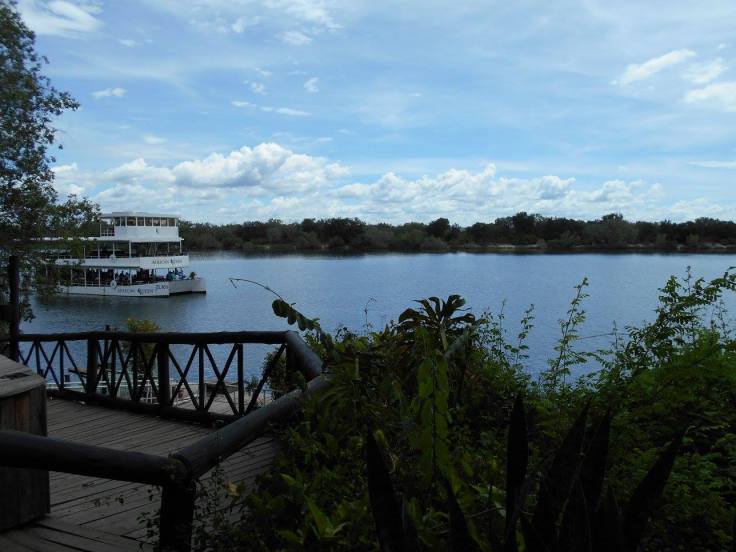
A riverboat on the Zambezi in Zambia, which reminded me of Memphis!
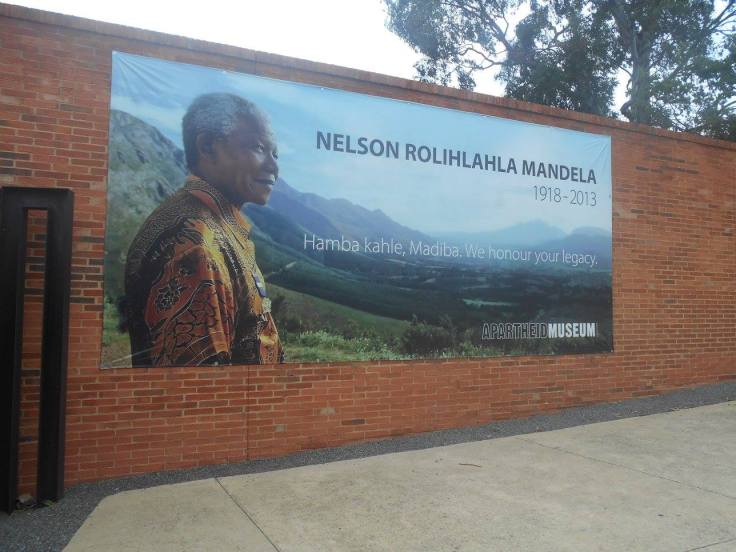
My visit to South Africa last December included a visit to the Apartheid Museum in Johannesburg. I went in with a general understanding of apartheid as a system of institutionalized racial segregation in South Africa in the late 20th century, mostly gleaned from brief overviews in a high school history class. However, I quickly realized how much more there was to learn from this painful chapter in history. The Apartheid Museum serves as a reminder that the struggle for equality still exists, in South Africa and around the world.
Below are a few facts I learned for the first time during the visit.
-Apartheid permeated every detail of a person’s existence. Each citizen was legally classified as white, black, Indian, or “coloured,” and was required to carry an identification card denoting this. This classification affected details as small as what alcohol you were allowed to drink (black people had to drink the lower quality “Bantu beer” as mandated by the government) and as big as where you could live (3.5 million black South Africans were removed from their homes and forced into segregated neighborhoods over the course of 2 decades).
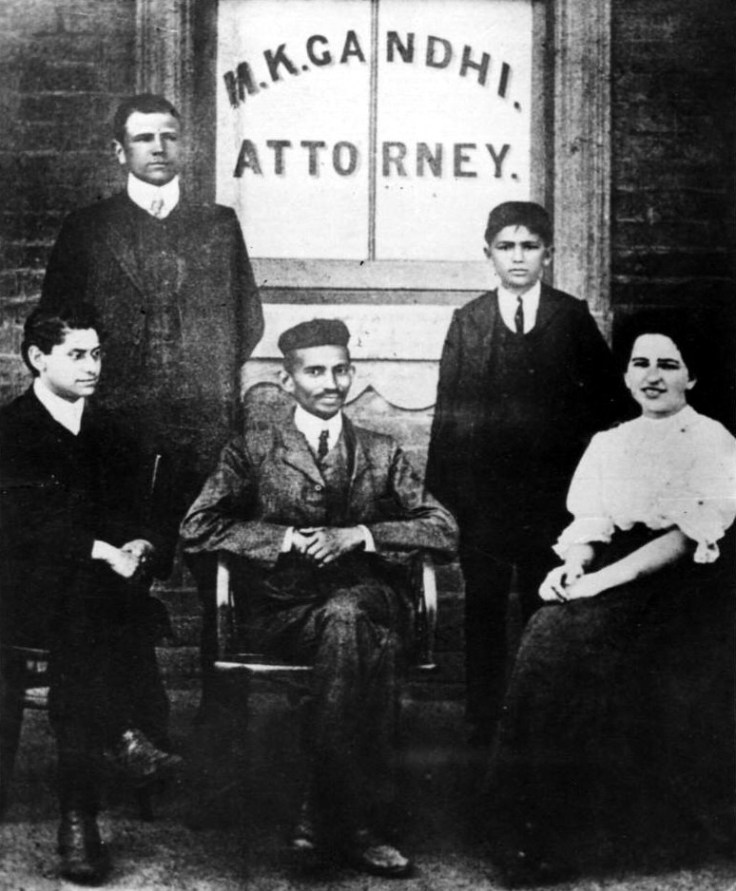
-Mahatma Gandhi lived in South Africa early in his life, and was a victim of the discrimination that served as a precursor to the apartheid system. In 1893, Gandhi purchased a first-class ticket for a train traveling from Pretoria. A white passenger complained about sharing the car with Gandhi, and Gandhi was forcibly removed after refusing to move to third-class. Gandhi became active in fighting discrimination in South Africa, and called this incident among the most important in his political career. Gandhi continued his work in South Africa until 1914, when he returned to India as Mahatma, meaning “a great soul.”
Gandhi as a young lawyer in Johannesburg, c. 1905
-The Soweto Uprising of 1976 saw schoolchildren, some as young as 13, come together to protest inequality in the education system. Essentially, the government led by the pro-apartheid National Party passed a law mandating all children be educated in the Afrikaans language. However, black South Africans spoke English. As Desmond Tutu said at the time, black South Africans viewed Afrikaans as “the language of the oppressor.” Can you imagine going to school and trying to learn math, history, and language in a language that was completely foreign to you, in your home country? This was exactly the problem faced by black South African students and teachers, who were now forced by law to communicate in Afrikaans only with English-speaking students. (It probably goes without mentioning, but the schools themselves were completely segregated along racial lines, and the black schools received much less funding.)
The students stood up for their right to an equal education. On June 16, 1976, 20,000 students and protesters marched in the streets and were met with violent backlash from the South African military, who used machine guns, dogs, and stoning to attack. It is estimated up to 700 protesters died during the uprising. June 16 is now Youth Day in South Africa, to honor the memory of these protesters.
As a former teacher of high school students, learning about the Soweto uprising shook me at my core. What are we doing in the US to fight for all students to have an excellent education? How are we empowering youth to stand up for their rights without fear of repercussion?
Schoolchildren protest oppression in education, Soweto Youth Uprising, 1976
-The “toyi toyi” dance/military march was adopted as a symbol of protest and unity among black South Africans after the 1976 massacre. The museum had several very moving video clips of the toyi toyi used in protest. I’ve included one from You Tube below. Although this is fake footage from a movie, it can give you an idea how powerful it was to see actual video footage of this.
-Nelson Mandela was released as a political prisoner on February 11, 1990 after 27 years of confinement, much of it in solitary confinement. While this is a pretty widely known fact, it still blew my mind to be reminded that this happened during my lifetime (I was 8 months old and in diapers when he was released!).
The South African flag was redesigned and adopted in 1994 to represent unity in a post-apartheid era.
-My tour included a visit to the Soweto neighborhood (a syllabic acronym for Southwest Township), where hundreds of thousands of black South Africans were forced to move after being forcibly removed from their original homes during apartheid. This is separate from the visit to the Apartheid Museum, but my hotel was able to arrange both tours and provide transportation. This neighborhood features the only street in the world with the addresses of two Nobel Peace Prize winners—Nelson Mandela and Desmond Tutu.
My visits to the Apartheid Museum and to the Soweto neighborhood were informative, inspiring, and humbling. I highly recommend the tours if you find yourself in Johannesburg.







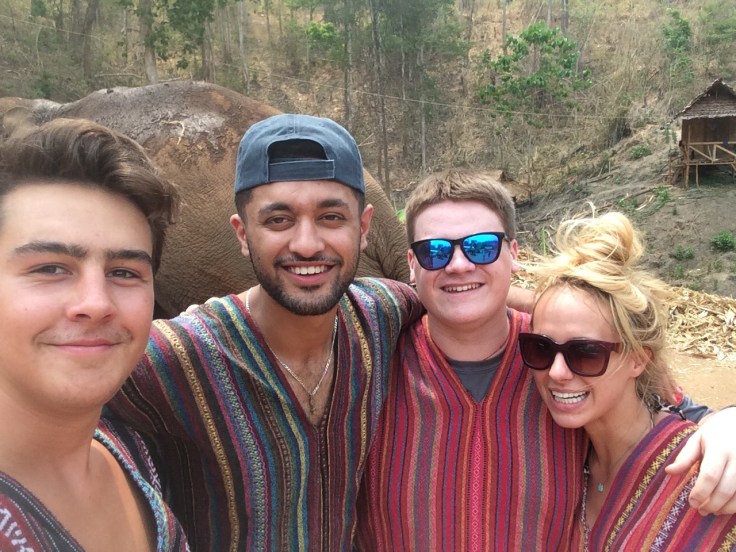 Then, we started feeding the elephants bananas. Elephants eat between 200 and 300 kilograms of food per day! The elephants were not shy at all, and actually followed us when they saw we had bananas in our hands! One elephant even almost mistook my iPhone in my hand as a banana…crisis averted! These elephants were very muddy, and it didn’t take long before I was very muddy.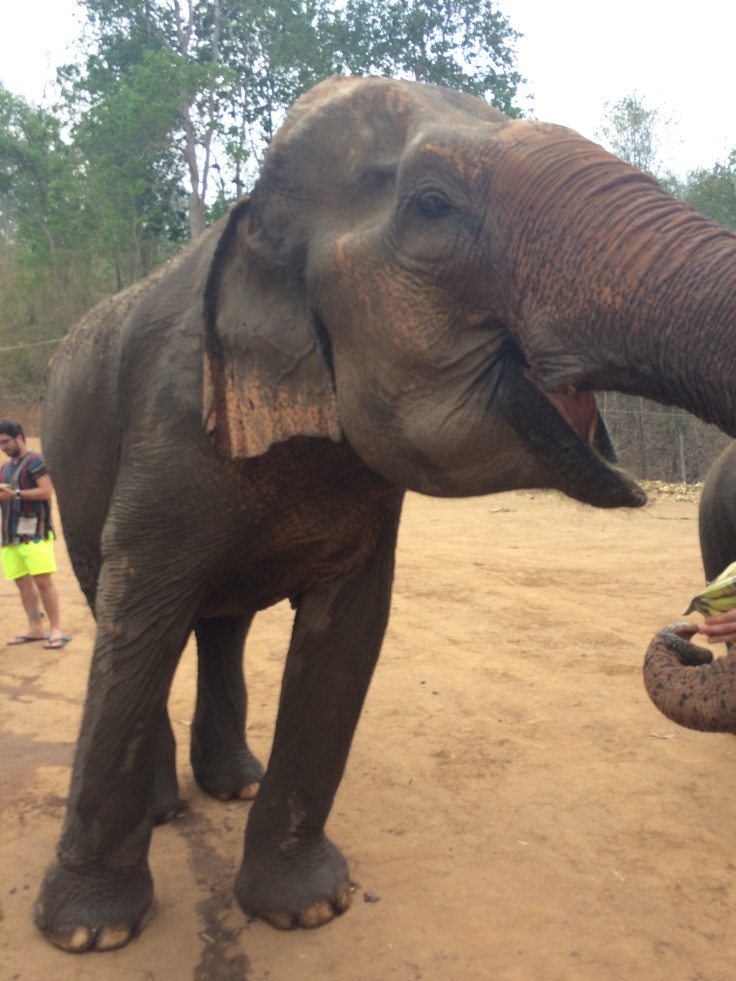







 “Travel is the one thing you buy that makes you richer.”


 My visit to South Africa last December included a visit to the Apartheid Museum in Johannesburg. I went in with a general understanding of apartheid as a system of institutionalized racial segregation in South Africa in the late 20th century, mostly gleaned from brief overviews in a high school history class. However, I quickly realized how much more there was to learn from this painful chapter in history. The Apartheid Museum serves as a reminder that the struggle for equality still exists, in South Africa and around the world.




 a southern yankee abroad
Recent Comments