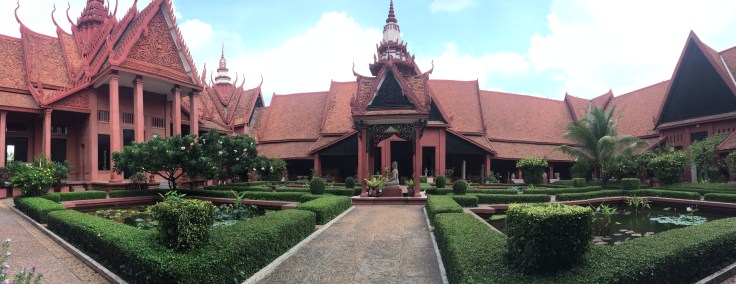
I’ve spent the last few days visiting the Cambodian cities of Phnom Penh and Sihanoukville. Phnom Penh is the capital of Cambodia. Here I visited the killing fields and genocide museum (which you can read about here). In the afternoon, I explored the city for a while on my own and ended up visiting the National Museum of Cambodia. It reminded me of the Met in NYC except much smaller and with only Khmer artifacts. There is a beautiful garden in the middle of the museum, where I spent some time reflecting. I also met an older British man here who was visiting Cambodia on “holiday” (what the Brits call vacation…I’m adopting this phrase!) and he ended up giving me some good life advice!
National Museum of Cambodia
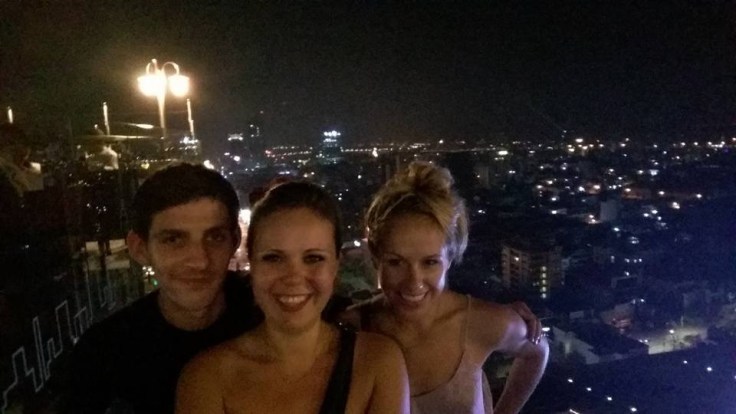
After meeting back up with my group at the hotel pool, we went to happy hour drinks at F.C.C. (Foreign Correspondent’s Club), which is apparently a well-known ex-pat bar. I really liked the neo-colonial vibe here. The bar featured riveting photography documenting the recent history of Cambodia. Also, the sunset over the Ton Le Sap River was very nice! After cocktails, we went to dinner at Friends, a local restaurant that supports non-profit work in the city (thanks for the recommendation, DJ!) and then on to a rooftop bar with a great view of the city!
F.C.C, Phnom PenhRooftop, Phnom Penh
The next day, we traveled to Sihanoukville, which is known as a backpacker’s beach town. The vibe here was very chill.
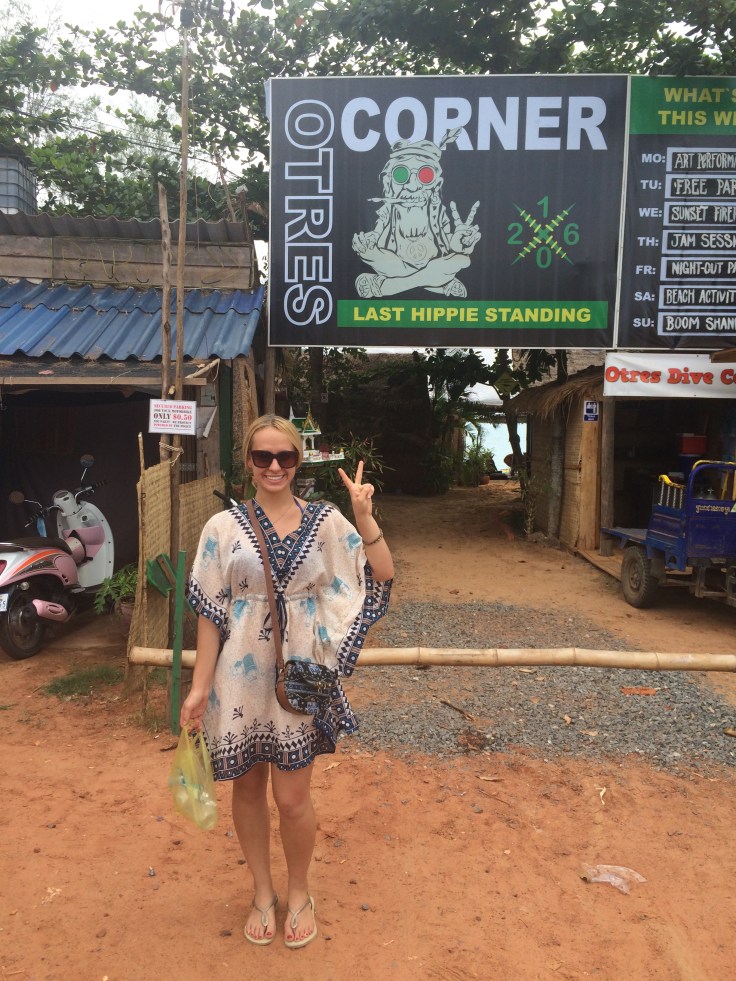
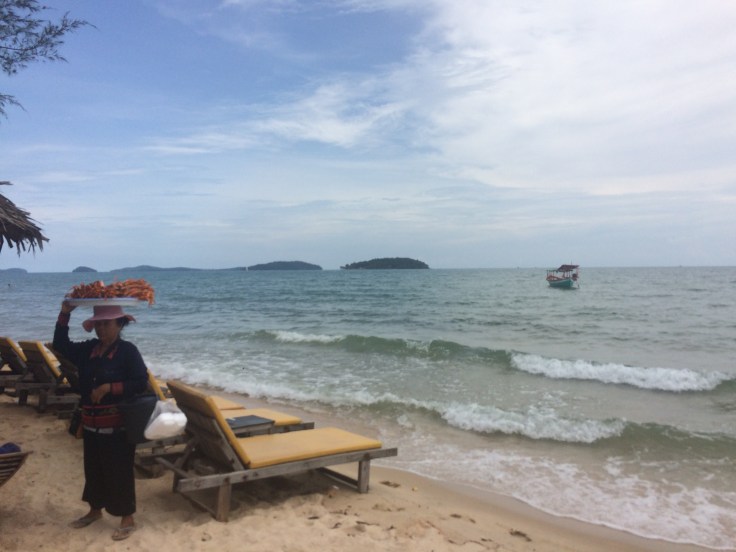
Otres Beach, Sihanoukville
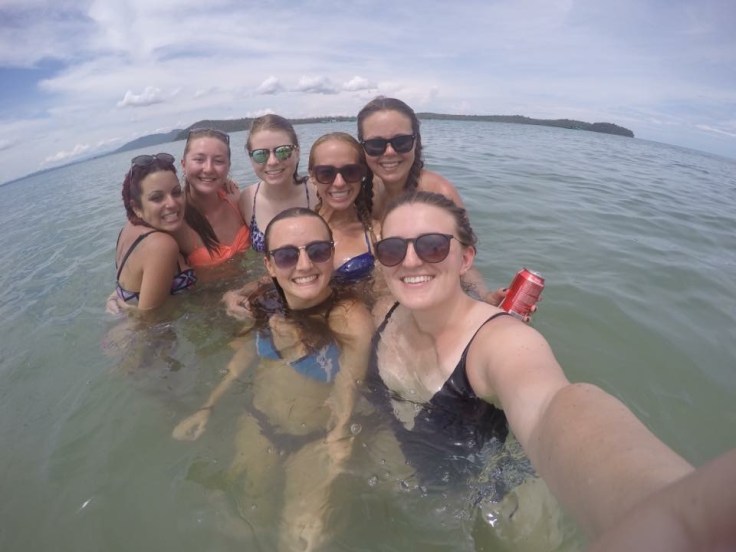
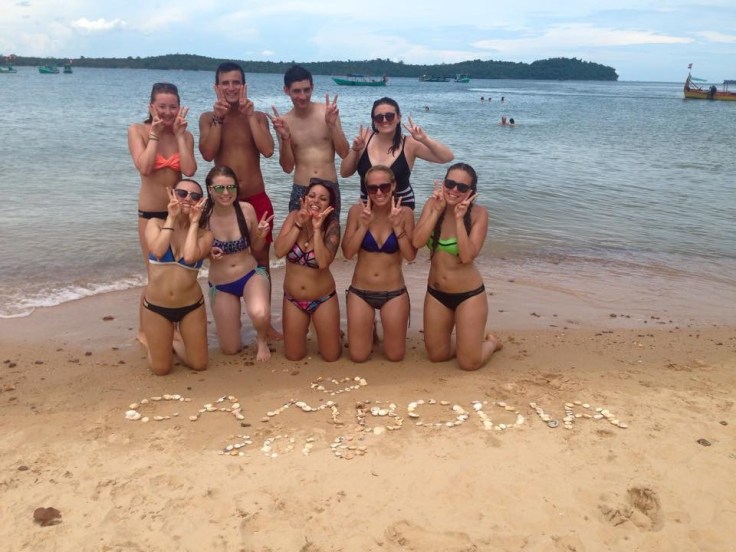
We spent the first afternoon on Otres Beach, and then took a boat out the next day for snorkeling, swimming, and barbecue on Bamboo Island. While the snorkeling was not as clear as some times I’ve been in Florida and Mexico, it was still very cool to see so many large sea urchins in the crevices of the coral. My favorite part was the boat ride back to Sihanoukville from the island–the water was super choppy and everyone got soaked over and over again!
Girl picture on Bamboo Island!The sticky rice family on Bamboo Island
Alexa’s and my hotel room in Sihanoukville was very…interesting, complete with lizards and an earthworm in the bathroom (I definitely wore my shower shoes) and a door handle that fell off on our last night. Fortunately, the hotel sent a guy to replace the our knob in the middle of the night…quite the adventure.
Now, it is off to Vietnam with the first stop being the Mekong Delta. Cambodia has been both beautiful and heart-breaking. I would love to return to this country at some point in the future. It has definitely made an impression on me.
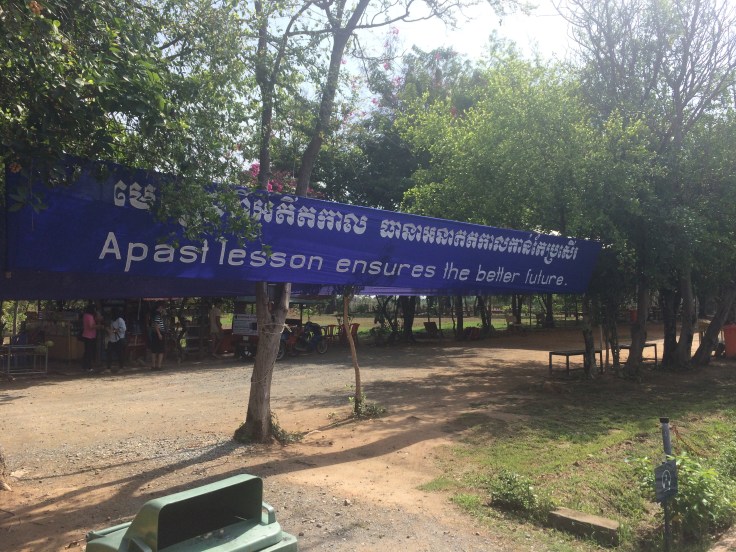
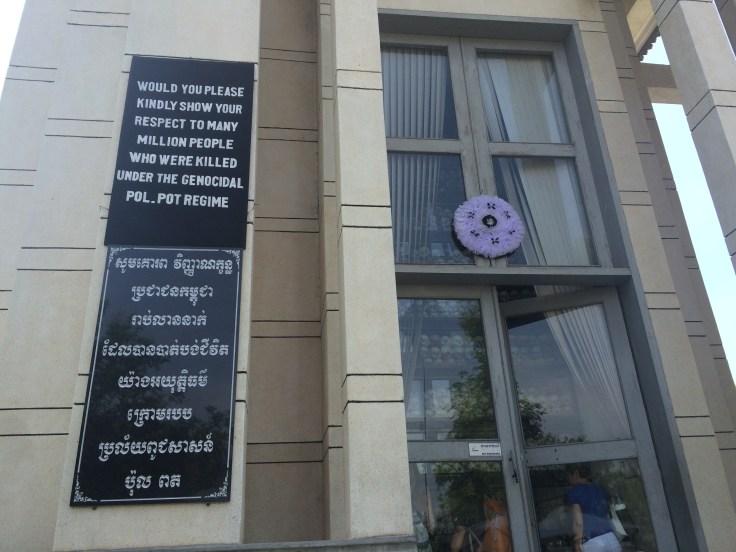
On Thursday morning, I visited the Chueng Ek killing fields and S-21 prison in Phnom Penh. I cannot put what I witnessed and learned into words, but I feel like it’s crucial to attempt to share this information. This post is quite difficult to write, and please be warned that some of the information shared is graphic and gruesome. However, in the words of Chum Mey, one of the survivors I met, it is important that the world knows what happened.
Between 1975 and 1979, 3 million Cambodians died under the Khmer Rouge regime. 1.7 million were murdered, and the rest died of starvation. The effects are evident in the demographics of the country today–only 5% of the people are over 65 years old, with 50% of the population under 20 years old. Only 15% of people with an education survived the genocide.
In 1975, a man known as Pol Pot came to power in Cambodia. His regime was known as the Khmer Rouge, or the Angkar. He won over the people in the countryside by delivering food and supplies to their villages, and promising a better life through communism for his people. However, his leadership soon turned into a reign of terror, as people were forced out of their homes and into hard labor camps in the countryside. Food was severely controlled and restricted, and many people died of disease and starvation as they labored under the control of Khmer Rouge soldiers.
“There are no diplomas, only diplomas one can visualize. If you wish to get a Baccalaureate, you have to get it at dams or canals,” stated one Khmer Rouge slogan. Although Pol Pot himself had been educated at a university in Paris, he banned all schools and arrested, tortured, and murdered educated people. If one member of a family was educated, the whole family was taken to prison, including the elderly, babies, and children. Teachers, doctors, policemen, and other professionals who could read and write were all targeted, as well as their families
From the prisons, the people were taken to a killing field, where they were brutally murdered. Because the Khmer Rouge thought bullets were too expensive, they used hammers, bamboo sticks, and cleaning rods to murder their victims. They would blindfold the victims and have them kneel in front of a mass grave, and then hit them from behind before pushing them into the grave. Many were buried alive. The murderers would bash babies against trees to kill them as their mothers watched. If the murderers noticed a victim was still alive, they would slit their throats with a tree branch.
I visited the killing field at the Chueng Ek Genocidal Center outside of Phnom Penh, but there were 343 such “killing fields” across Cambodia. Despite excavation, there are still human bone fragments scattered throughout the field, even in the walkways. When it rains, bone and clothing fragments still come to the surface of the soil. There are still blood stains on the tree where babies were murdered. As I walked through, I found myself without words and then asking how God could allow this to happen.
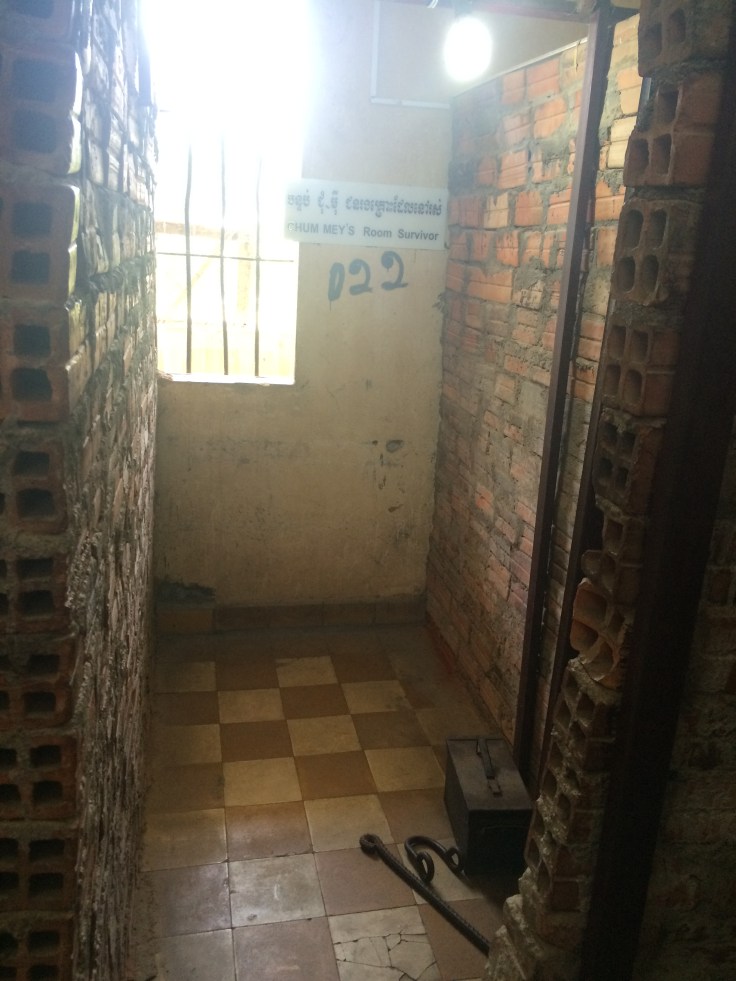
After the killing field, we visited the S-21 prison in Phnom Penh. This is where 17,000 prisoners were held during the Khmer Rouge regime. Out of 17,000, only 7 survived. The guards tortured prisoners with electrical shocks, acid, beatings, and salt water over wounds in an attempt to extract information that would aid the Khmer Rouge. Prisoners were forced to use a small metal box for their bodily waste, and it was only emptied once every 2 weeks. If it spilled before then, they were forced to clean the floor with their tongues. Prisoners often ate bugs and rats that crept into their cells to avoid starvation, and many starved anyway.
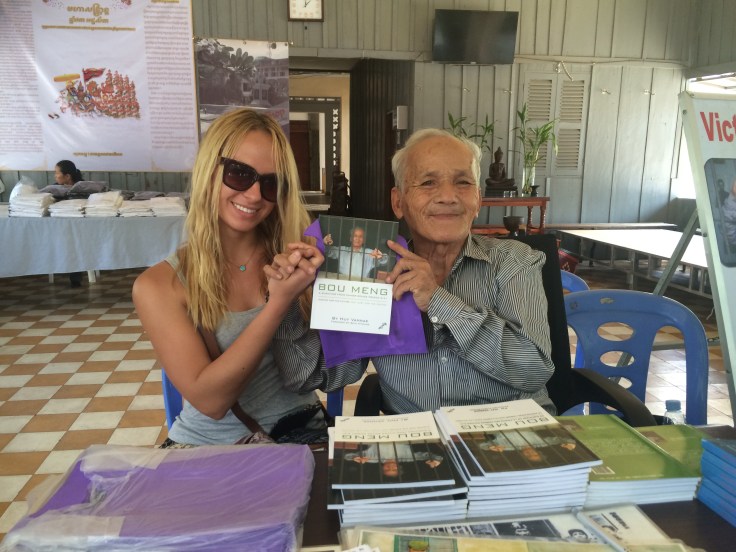
Of the 7 survivors, 2 are still alive today. I was able to meet both Chum Mey and Bou Meng, who have written books about their experiences and now work to educate visitors about the genocide and seek justice. Bou Meng, his wife, and their 2 children entered S-21 in 1975, and he never saw them again. Bou Meng was an artist, and he was able to survive because the Khmer Roge commissioned portraits of Pol Pot and other communist leaders from him. Every day, he was tortured and wondered if it was his last day to live. He did not learn his wife’s fate until 2008, when he confronted his torturer face-to-face at the ECCC trial. He there learned that his wife had been murdered at the Chueng Ek killing field. He still carries her picture in his wallet.
Bou Meng’s story was published as part of a dissertation by a Rutgers student. The following excerpt stands out to me: “Now, he said, the ghosts of those who died follow him, hovering over him in the dark, still skeletal from starvation, still wearing the black clothes that were the uniform in Khmer Rouge times. They gather in front of his home, calling out to him to represent them and to find justice for them.”
Meeting Bou Meng
Justice is still lacking. Many former Khmer Rouge leaders and soldiers are part of the modern government. In fact, the US, Britain, and other democratic countries still recognized Pol Pot as the leader of Cambodia until 1991, despite his evil atrocities. Him Huy, who was the head guard at S-21 and personally tortured Bou Meng, still accepts money to give tours of the prison and to talk to journalists. The history of the genocide is not taught to Cambodian students at all in school, because the government is still trying to hide what happened as much as possible. It is our job to be educated about this, to seek justice for these victims, and to ensure that this never happens again in our world. Cambodia is still recovering from this period of history, and it is very evident in the infrastructure, healthcare, and education systems in the country. We need to do everything we can to help this country move forward and heal, and to ensure its future includes hope and justice.
After arriving in Siem Reap Monday night and settling into the hotel, our local guide had arranged for us to have dinner in the home of a local who runs a school for children in the town who cannot afford to go to school otherwise. After a delicious meal (amok and curry!), we were able to visit with several students who live nearby who wanted a chance to practice their English. I spoke with some high school students who had pretty developed English skills, and they told me knowing English is really important to get a good job here.
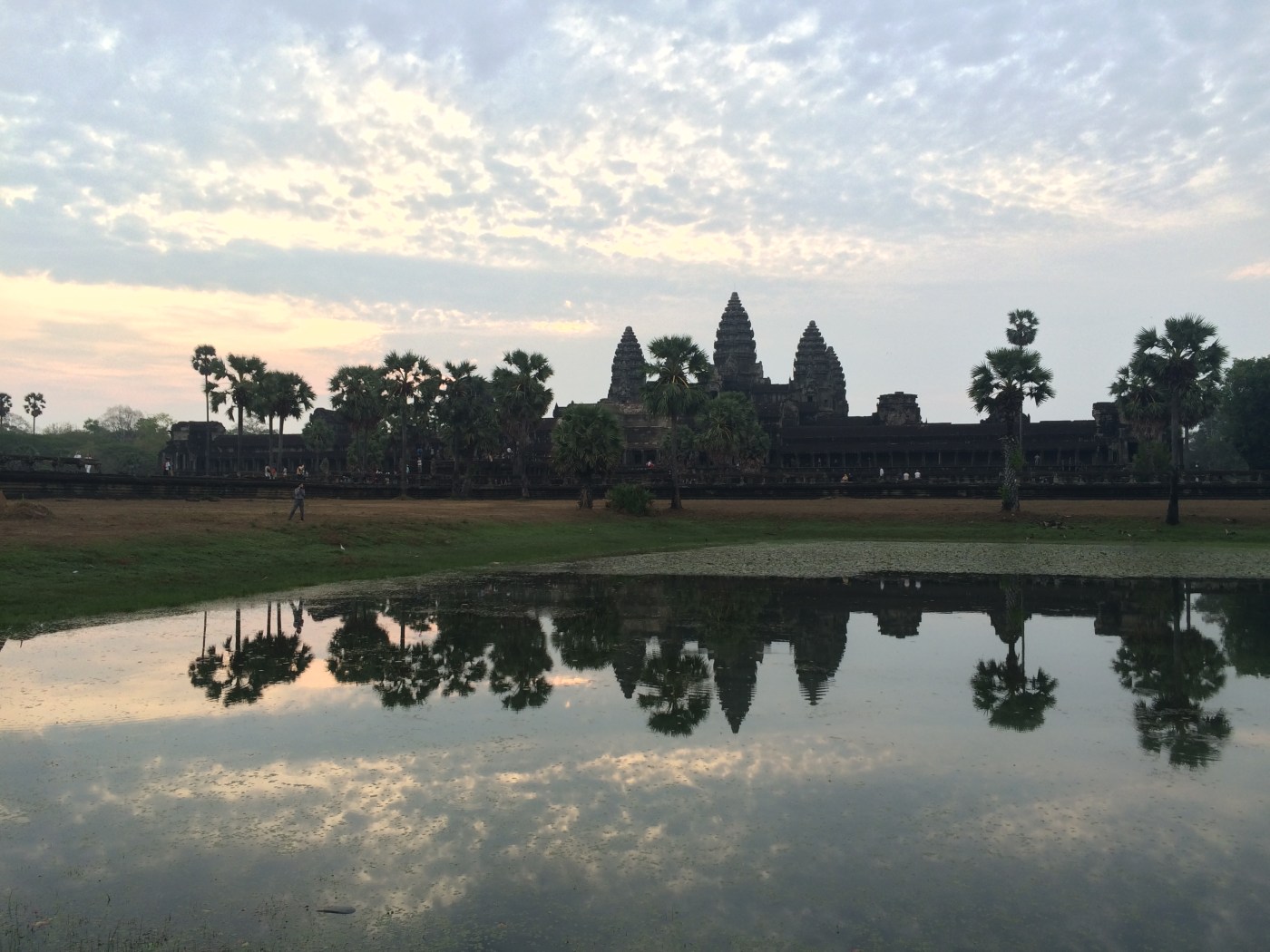
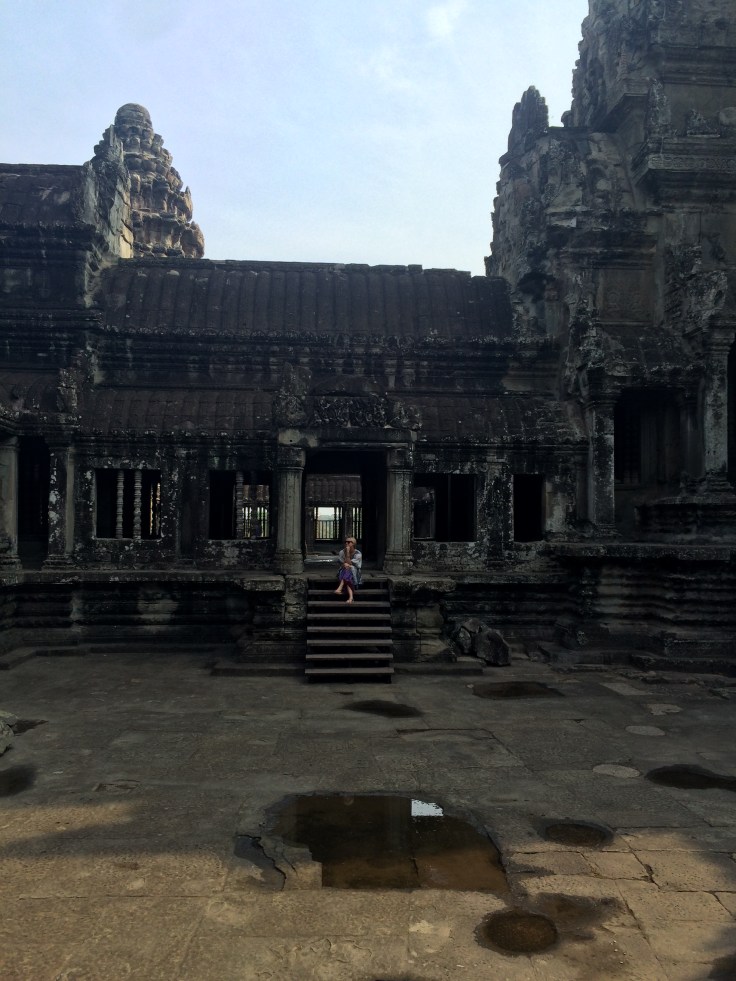
The next morning, we left at 4:30am to head to Angkor Wat for the sunrise. It was absolutely beautiful. Even though it was slightly overcast, the way the light reflected off the temple and changed the colors of the reflection in the water was still breathtaking.
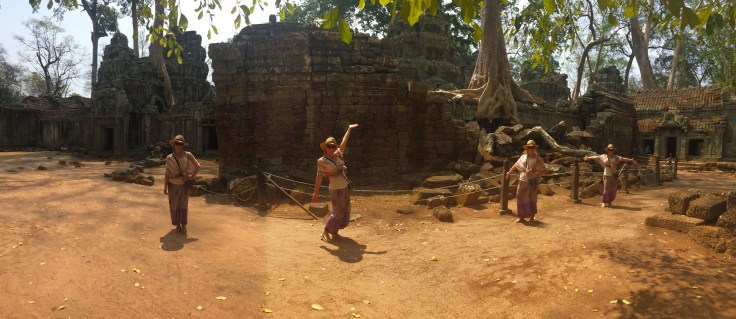
Angkor Wat is the largest religious monument in the world. It was built as a Hindu temple in the 12th century and was later converted to a Buddhist temple. It took 35 years to build! Our guide, Bunni, did a great job of explaining all of the history behind the architecture. Bunni also shared with me he was never able to attend college because of the Cambodian genocide (the genocide was targeted toward educated people), but his daughter is now in college. He was absolutely fantastic and great at taking pano shots on the iPhone!
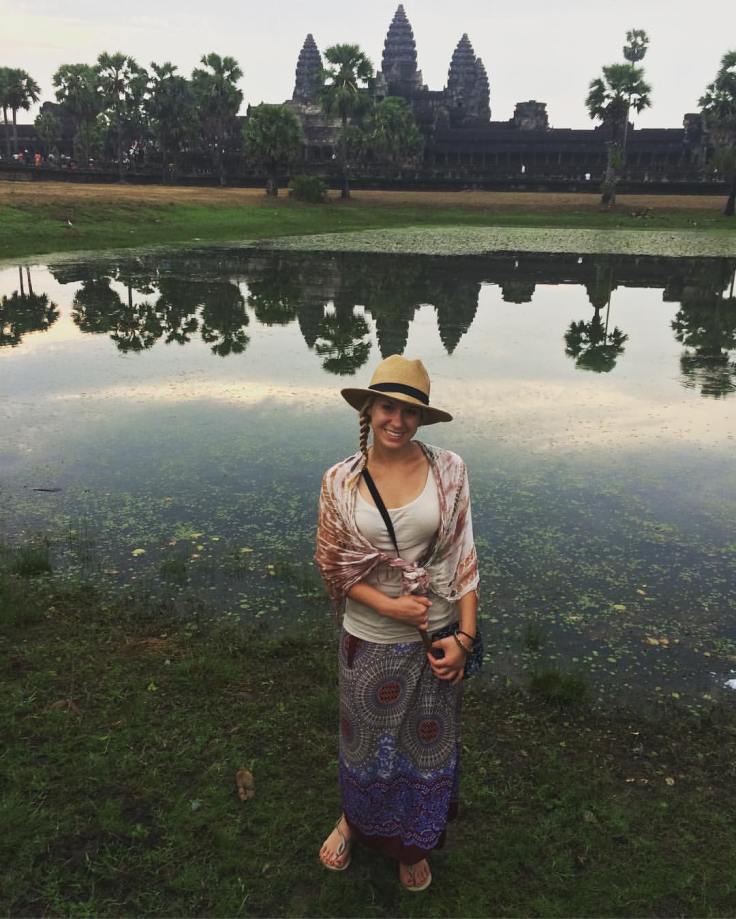
My favorite part of Angkor Wat was climbing the very steep and narrow staircase to Bakan, or the highest level of the temple which represents heaven. To enter Angkor Wat, I had to cover my shoulders with a scarf. However, to enter Bakan I had to cover up even more with a tunic I bought for $3 on the side of the street, and remove my hat. Bunni said that to visit Bakan, you were only allowed to think positive thoughts and had to leave all negative thoughts behind. This was amazing experience!
This is me thinking only positive thoughts while visiting Bakan!
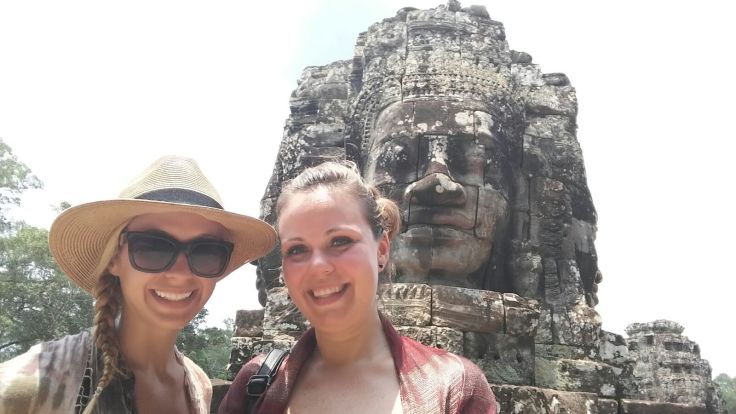
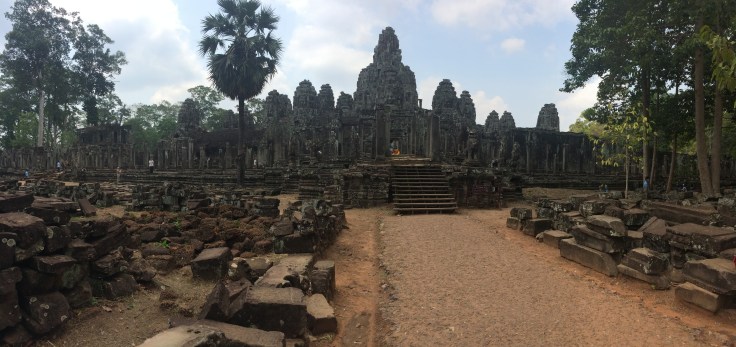
After watching the sunrise and touring Angkor Wat, we went on to the temples at Ta Prohm and Bayon. Ta Prohm and Bayon were also beautiful. Ta Prohm is the temple where Tomb Raider was filmed and the trees are growing over the temple. Bayon is the temple most famous for its stone faces. They were both also built in the 12th century and combine Hindu and Buddhist elements.
One of Bunni’s really cool pano shots at Ta Prohm!Ta ProhmBayonBayon
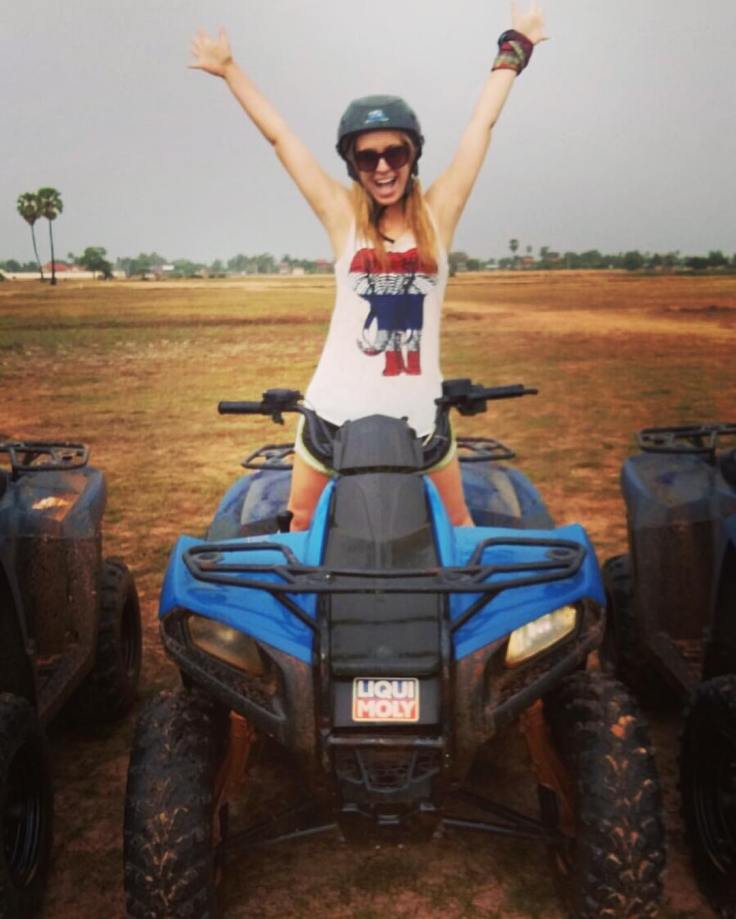
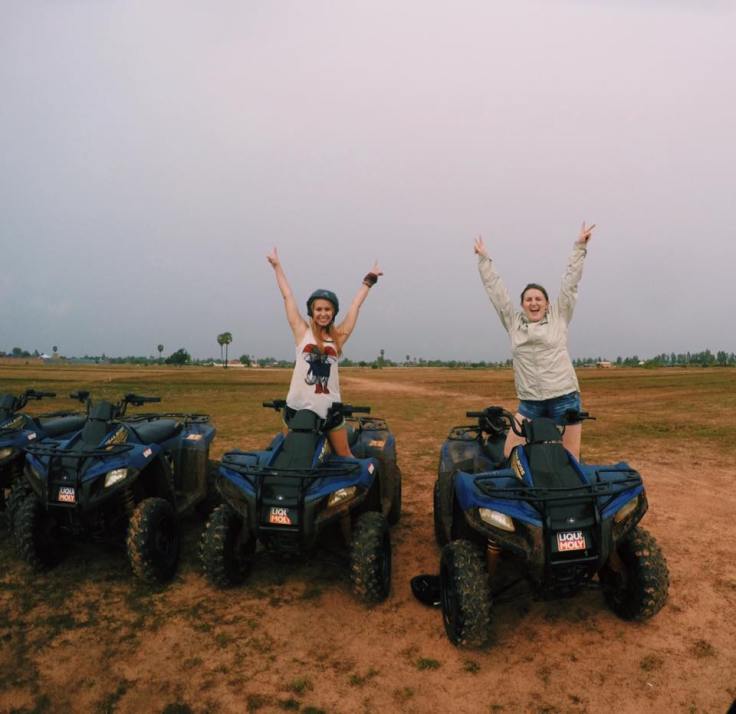
In the afternoon, I relaxed by the pool for a bit then joined in on a “quad bike” ride through the Siem Reap countryside. In the US, we call these four-wheelers. By a stroke of good fortune, it was raining, so we hit lots and lots of mud! I also made some small jumps and almost slid off the bike a few times…so much fun! This was definitely a full circle moment for me. In Alabama, this is called mud riding, and the world seemed a little smaller to me as I flew through the mud puddles around Siem Reap. 🙂 It was also very interesting to see the agriculture and some rural areas outside of the city.
Hailey and I were the fastest 2!!
Siem Reap has been charming and informative…next stop is Phnom Penh!
The trip to Bangkok went smoothly Sunday morning. I was able to visit the post office in the airport and send some postcards and a small box full of things I decided I didn’t need back to the U.S. I shipped the box to my cousin for safe-keeping (thanks Valerie!) until I get back to the US for only 1,450 baht (about 40 USD). My backpack feels so much lighter already, and now I won’t feel guilty about buying things! 🙂
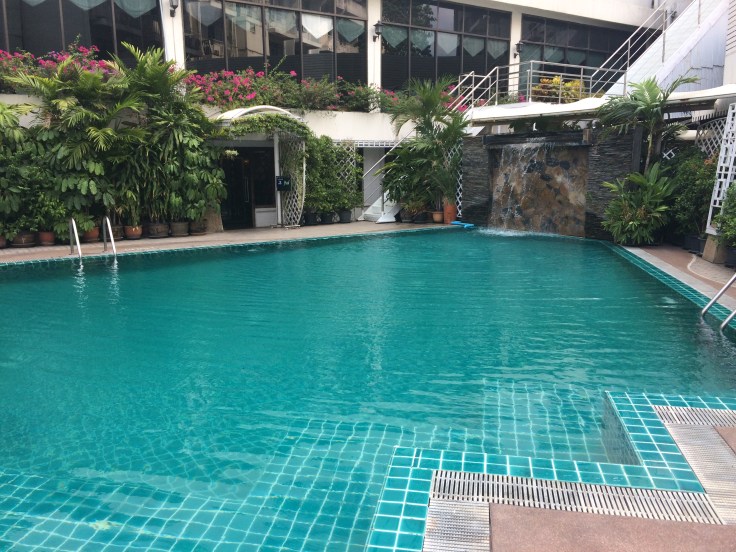
Once in Bangkok, I took a car to my hotel (arranged through the group I am traveling with, G Adventures) and checked in. I was very excited to see the hotel was pretty nice…although I’d only stayed in a hostel 3 nights in Chiang Mai, I realized how much I like having space and privacy! I will be in hotels for the rest of SE Asia, and then will be in hostels the rest of the summer, I am now thinking I may have to treat myself to a hotel every now and then later in the summer as the budget allows! Instead of sightseeing, I decided to relax by the pool for the afternoon, which was an excellent decision.
Around 6pm, Alexa (roommate from Germany, also traveling solo!) and I met up with the rest of our travel group, where we met a third solo female traveler (from Australia). The six other people in the group are from Canada and Britain. Just as it was in Africa, I am the only American in our group…evidence that Americans need to travel more! 🙂
After meeting up, we all went to dinner and then took tuk-tuks to Khaosan Road. This is where it got interesting! Khaosan Road is ridiculous! It is like the Thai version of Bourbon Street in New Orleans or Beale Street in Memphis. Perhaps it was a little touristy and over the top, but I absolutely loved it. After a lot of dancing, people-watching and experimenting with food (Alexa and Jemma tried scorpion! I observed…), we headed back to the hotel to get some rest.
In Chiang Mai, people told me I would not like Bangkok because it was dirty, hot, and too busy. Ironically, these are exactly the reasons I liked it so much! It’s definitely on the gritty side, like NYC :-), but I really enjoyed it. I do feel a little guilty for chosing the pool over seeing temples or the Grand Palace, but I will just have to catch those next time. 🙂 This morning, we drove from Bangkok to cross the border into Cambodia at Poipet. While walking the 10 minute stretch across the border, it immediately struck me how much poorer Cambodia is than Thailand. Thailand is very developed and luxurious compared to Cambodia. I also learned that no education is free in Cambodia–not even primary school. (In Thailand, primary school is free but nothing else.) I have only been here for an hour and am already floored by what I am seeing and learning.
On the way to Siem Reap, we stopped at a roadside restaurant and I had my first Cambodian meal–fish amok with an Angkor beer. Very on point and so delicious! Tomorrow, it’s on to Angkor Wat!
Chiang Mai has been a perfect start to the trip! After going to dinner and out with some very new friends on Thursday night, I woke up at 6am on Friday (thanks jetlag!) to plan my next 2 days in Chiang Mai. Fortunately, my hostel had a full-time travel agent on staff who was able to help me plan some fun things.
I spent Friday morning exploring the area. After shopping for a bit and trying to talk myself out of buying items to add to my already heavy backpack, I wandered past Wat Bupparam on Tha Pae Road (a wat is a temple!). I walked through the gates to check it out, and noticed a monk doing his chants in a small side temple on the complex. I took my shoes off and stood outside, not wanting to interrupt but curious all the same. He looked up from his pages, smiled, and waved me in. I sat with him as he finished his chants. I couldn’t help but feel very humbled as I sat with him–just the 2 of us in the temple. I was not planning to take a picture, as I assumed this would be disrespectful. However, after he finished his chant, he gestured for me to take a picture. I asked/gestured to see if he was sure this was ok, and he smiled and nodded his head. So here’s my monk friend…I am so grateful that he made me feel so welcome, even though I was clearly very awkward and lost!
My new friend 🙂
After more wandering around, I then spent the afternoon at the Elephant Jungle Sanctuary (you can read about that here).
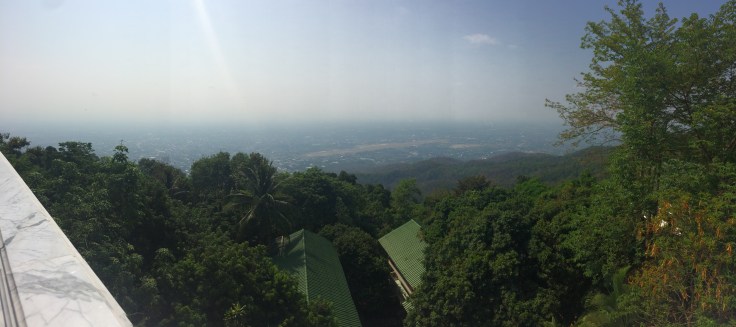
Saturday morning, I headed to Wat Phra That Doi Suthep with one of my Canadian friends from Thursday. The trip to the wat took about 30 minutes in a songthaew (a taxi where you sit in the back of a pick-up truck!) and the ride was a very steep uphill climb. Once there, we trekked 300 steps to reach the wat, removed our shoes and explored the temple. It had an amazing view of Chiang Mai!
The sassy monk statue on the right is throwing shade!View of Chiang Mai from Wat Doi Suthep
After visiting Wat Phra That Doi Suthep, we took a cruise of the Ping River to a small farm down the river. The other two people in our boat happened to be Bible translators. I learned that over 1,500 of the 6,000 spoken languages in the world have no written form.Their work is to visit remote villages in areas of the world where there is no written alphabet and work with the people there to use an international phonetic alphabet to create a written language. They then translate the Bible, as well as information regarding best agricultural practices and healthcare that can be helpful to the community. At the farm, we visited the various crops and had a delicious lunch of lemongrass juice, longan juice, tamarind juice, and fruit before cruising back to Chiang Mai.
The cruise passed the summer home of the princess of Thailand!
Above: U.S embassy in Thailand, black chickens, and a man fishing
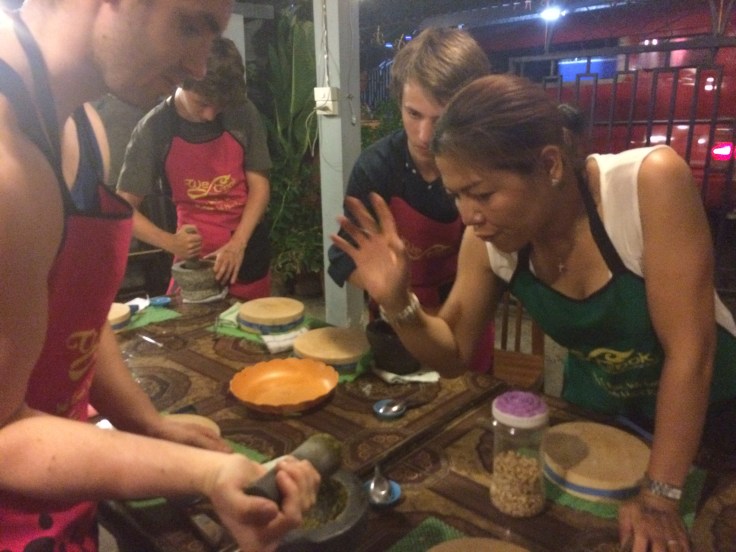
After relaxing back at the pool at the hostel for a bit, I went to a cooking class with Mam at We Cook. After visiting an open air market to buy ingredients, we headed back to Mam’s house, where she taught us all about Thai cooking. Mam is absolutely fabulous…I learned a lot about strong flavor groups and balancing sweet, salty, hot, and mild flavors. The class was full of several other solo travelers, and by the end of the 5 hour class, we were all good friends after laughing at each other for 5 hours. I made spring rolls, green curry, tom yam soup, pad thai, and sticky rice with mango. Yum yum!
Crushing spices for green curry. It’s hard work!Mam checking our work. She demanded excellence!
Tomorrow, I say goodbye to Chiang Mai. It is such a special place, and I’m happy it was my very first stop for the summer!
This afternoon, I hopped in the back of a pickup truck with a few other friends from my hostel and rode 1.5 hours through the hills outside of Chiang Mai to visit the Elephant Jungle Sanctuary. The sanctuary is a camp for elephants who were formerly used in the riding business. Many people aren’t aware that riding elephants actually hurts the elephants over time, as their bodies are structured to carry weight in their lower bodies and not on top. Elephants are also harmed by the equipment used in the riding business, such as straps and hooks. The average lifespan of an elephant used for riding is about 20 years shorter than other elephants.
The sanctuary, as well as camps and parks with a similar focus, is harnessing the tourism industry to change the way elephants are perceived and treated. Elephants were once used by their owners in the logging industry. When that industry dwindled, elephants were then transitioned into the tourism industry as a riding attraction. The elephants are owned by “mahouts,” or elephant trainers, who train the elephants to do tricks and to be ridden and then lease the elephants to tourism companies. By introducing a sanctuary experience as an “ethical alternative” that consistently attracts consumers, the sanctuary pitches itself to the mahouts as a better (the mahouts don’t want the elephants to suffer either, but they have to find ways to cash in on their investment), more lucrative, and more promising business choice for their lease. The sanctuary then attracts tourists to come and feed, bathe, pet, and rinse the elephants, and uses the money made to pay the mahouts as well as operational costs. Mahouts make money, the elephants are treated well, and tourists can take part in a fun experience. The sanctuary will also buy riding elephants with its own funds, and these elephants become permanent residents of the camp. All other elephants are on lease from their mahouts.
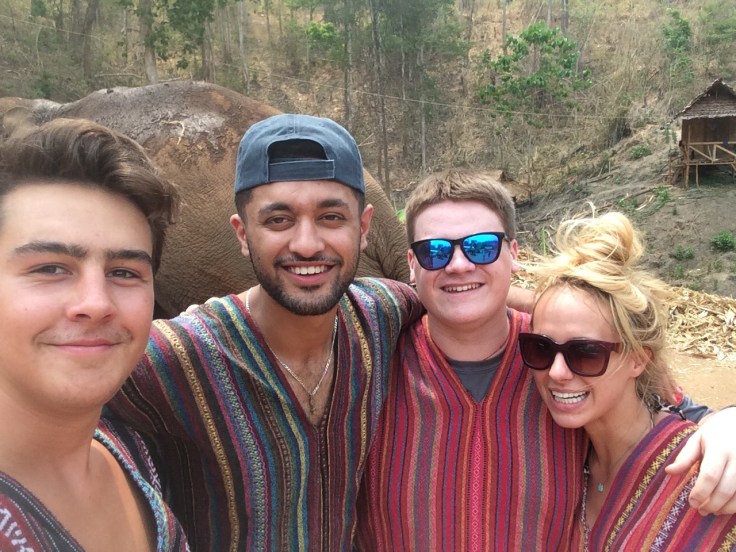
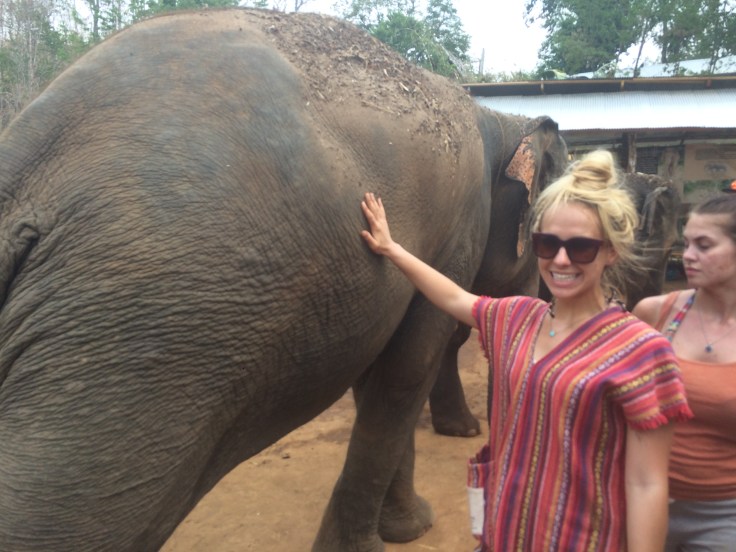
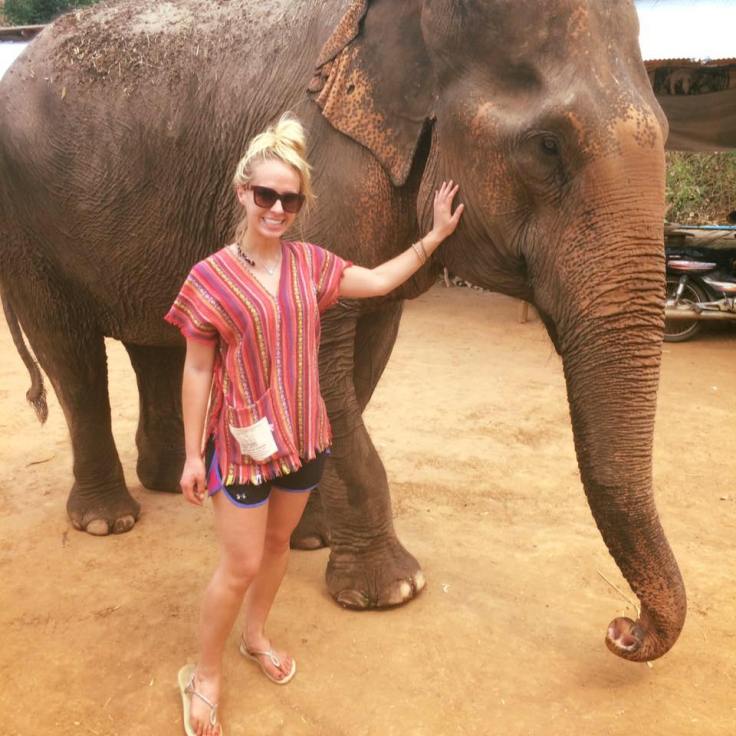
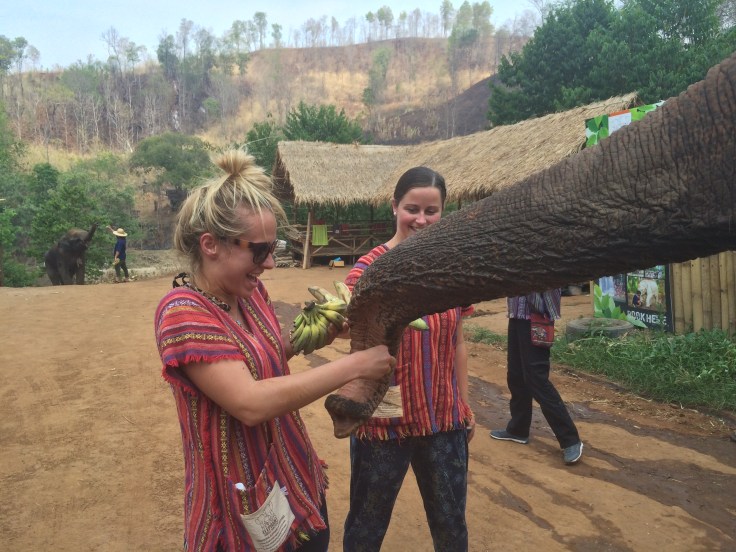
So what did we do with the elephants? First, we had to put on a traditional Karen tribal tunic. The guides told us this is so the elephants would feel comfortable around us (maybe this is true, or maybe it’s something they just tell tourists…who knows!) Then, we started feeding the elephants bananas. Elephants eat between 200 and 300 kilograms of food per day! The elephants were not shy at all, and actually followed us when they saw we had bananas in our hands! One elephant even almost mistook my iPhone in my hand as a banana…crisis averted! These elephants were very muddy, and it didn’t take long before I was very muddy.
The elephants are so excited to get bananas from visitors!!
This was very fitting, as we next took the elephants to a mud pool and got in the pool with them to give a mud bath. Yes, I swam in the mud with the elephants! I have never been dirtier in my life, and it was fabulous! My biggest concern was being careful that the elephants didn’t accidentally step on me or one of my friends. We were a few hours from any town, so this would be a bad place to break a foot! After the mud bath, we followed the elephants down to a river and rinsed and scrubbed them. Then, we left the elephants behind and trekked to a beautiful waterfall in the jungle and went for a swim. By this point, I was covered in mud from head to toe, so I took the chance to rinse off in the surprisingly cold water. Afterward, we all had a delicious meal prepared by the camp workers, and then hopped on the back of the pickup to go the 1.5 hours back to Chiang Mai. Given the winding and bumpy road and exhaust fumes from the truck, we were all a little nauseated, but that was a small price to pay for such a beautiful and magical day!
This elephant is pregnant and you could feel the baby elephant kicking!! Her baby will get to live at the sanctuary with her 🙂
I’ve finally arrived to my first overseas destination in Northern Thailand! I will be spending a few days here solo before heading to Bangkok on Sunday to meet up with a group. I arrived after layovers in Chicago, Vancouver, and Shanghai, for a total of 35 hours of travel time. Yes, Memphis → Chicago→ Vancouver→ Shanghai→ Chiang Mai. Crazy, but I did it!
Surprisingly, the Memphis airport was the busiest I have ever seen it on Tuesday afternoon. It usually takes less than 15 minutes to check in and get through security. It took about 45 minutes on Tuesday. Fortunately, I made it to my gate just fine with about 10 minutes to spare. My dad saw me off at the airport. I am so glad I was able to spend time with him this week, as well as with my mom, other family members, and friends over the last few weeks before the leaving the U.S.–it meant so much to me!
Once I arrived in Vancouver, I realized quickly that the Canadian version of TSA is so strict! Even though all of my shampoos and conditioners were in small bottles, they said I had too many bottles, so I had to throw some away. I didn’t want to be “that girl,” but I really wanted to explain to him how picky I am about my hair products, and I needed to take all of these with me to last for 3 months! However, I kept my mouth shut and sadly threw several away in order to be in compliance. I was annoyed then, but now I realize it’s pretty hilarious I had so many tiny bottles in my backpack. Also, my backpack is a little lighter now!
In Vancouver, I boarded a 12 hour flight with China Eastern to Shanghai. Unfortunately, I had looked up China Eastern on Yelp the night before, and was thoroughly freaked out by what I read. It seemed all of the reviews talked about how horrible the airline was, regarding everything from the manners of the crew to leg space to food to safety. One reviewer even talked about how his flight had been in freefall multiple times, and he thought he was going to die as he and the other passengers screamed the whole flight! Needless to say, this made me even more nervous.
However, the flight could not have been smoother. We flew over Alaska, the Bering Strait, and Russia, barely crossing the Pacific (This was important to me, as I get nervous about flying over large bodies of water. If you have to emergency land, where do you go?!) We even flew around the edge of North Korea (!) and landed in Shanghai ahead of schedule. The layover in Shanghai airport was very relaxing, as I accessed the free wifi to text and FaceTime with friends and family and found a Starbucks for a “just like home” coffee fix! The only downside is that I was unable to check both my Gmail and Facebook, as the Chinese government has blocked both. I also wasn’t able to use Google for the same reason. I’ll never take these sites for granted again!
Once I finally arrived in Chiang Mai, I hired a tuk-tuk (basically a motorcycle taxi) outside of the airport to take me to my hostel. I was able to bargain with him to reduce the price from 200 baht to 160 baht! He swore he knew where my hostel was, but it was only after 45 minutes of riding around and stopping to ask 6 people that we ultimately found it. I am not complaining though…the ride was fun and I was able to get a good first look around Chiang Mai! The first night in Thailand was a complete whirlwind, mostly due to extreme tiredness and adrenaline. I made friends with a group of Canadians at my hostel, and we went to dinner and then to a “disco” (just a bar really…but it’s fun to call it a disco!) I’m excited to see what the next few days in Chiang Mai hold!!
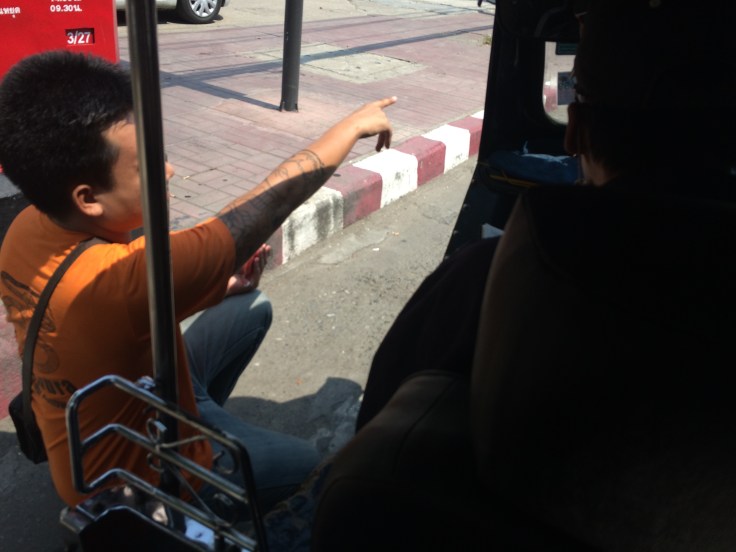
Tuk-tuk selfie (no shame!) Delirious and excited after 35 hours of travel!Asking directions (again). I didn’t think we would ever get there…everyone was extremely nice and tried to be very helpful though!
One of the most important items to take on a big trip is a playlist. I think the music we are listening to at a given point of our lives is reflective of where we are in that moment. To celebrate kicking off my overseas travels, I’ve decided to share my playlist for my big trip on the blog. As my friends often point out, I have a very random and assorted taste in music. I am sure this playlist reflects that. There is really no organizational scheme here–these are all just songs I love and that I’ll be listening to on my flights. Enjoy!
Traveller – Chris Stapleton. What better song to kick off the playlist than a song about traveling? “Every turn reveals some other road.”
I Took a Pill in Ibiza – Mike Posner. I probably heard this song about 100 times before I actually listened to it, and it’s fantastic. I love the original (in the link!)
Good Life – OneRepublic. “To my friends in New York, I say hello.”
The entire Lemonade album – Beyonce. I didn’t think any other song on this album could be as amazing as “Formation,” but every song on this album is just as amazing, if not even better. Beyonce’s sound on Lemonade is different from anything she’s ever done before, and her raw emotion is unprecedented in her work. She even dabbles in (and totally crushes!) country on the song “Daddy Lessons” (which I was sure to learn on my guitar before I put it in storage for the summer! Here is a Dixie Chicks cover, but I think Beyonce still does it better.) Also, who is Becky with the good hair?! The world may never know the whole truth…. TexasBama!
We Didn’t Start the Fire – Billy Joel. Every history nerd’s favorite classic. “We didn’t start the fire, no we didn’t light it but we tried to fight it.”
King Kunta – Kendrick Lamar. “I got a bone to pick!”
Good Ol’ Boys Club – Kacey Musgraves. “Another gear in a big machine don’t sound like fun to me.”
Southern Comfort Zone – Brad Paisley. (This one’s for you, Alex!) This song is so cheesy, but it really says so much, and I kind of love it. So, it’s going on the playlist! 🙂
Chop My Money – PSquare. I was introduced to this rapper’s music in Africa…great memories.
This Must Be the Place – Talking Heads. “Home is where I want to be, but I guess I’m already there.”
Heart Like Mine – Miranda Lambert. “He could calm the storm and heal the blind, I bet he’d understand a heart like mine.”
Greatest Hits – Dixie Chicks. I am so sad I will be missing them at Madison Square Garden on my birthday this year!! But, I will be in beautiful Peru, so I really can’t complain. Who doesn’t love Wide Open Spaces, Not Ready to Make Nice, Goodbye Earl, Sin Wagon, and Traveling Soldier? I can’t pick just one, so it’s all going on my list!
Romeo and Juliet – Dire Straits. One of my favorites since I was 13…sigh. 🙂
Home – Edward Sharpe and the Magnetic Zeros. “Home is wherever I’m with you.”
The General – Dispatch. “I have discovered this fight is not worth fighting.”
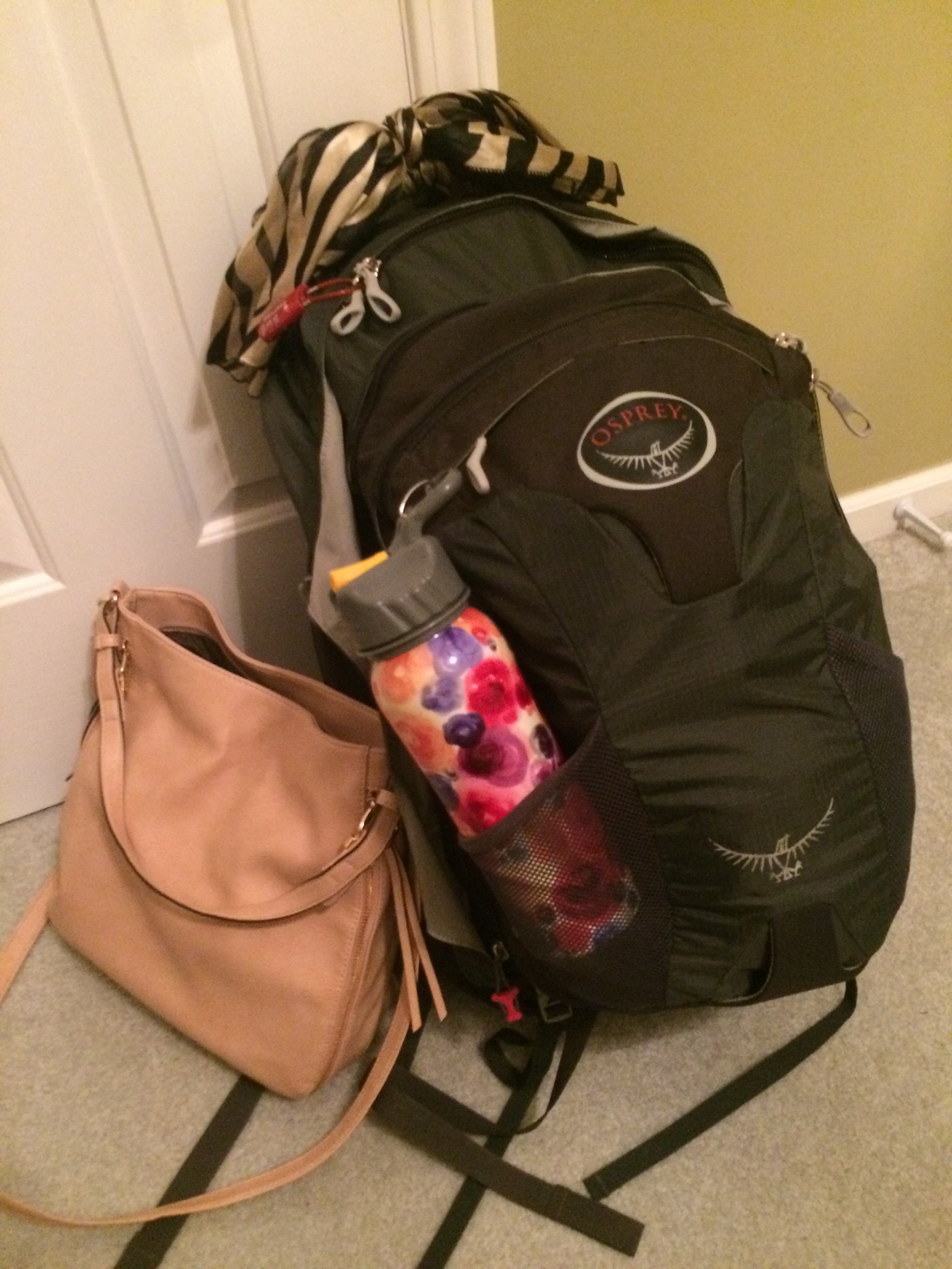
In the last month, I’ve discovered just how complicated packing a backpack can be. My 55 liter Osprey will have to fit all the belongings I need for the next 3 months. To make things even more complicated, I will be traveling to the hot and sticky climate of Southeast Asia, then to the cold and dry high altitudes of the South American Andes, and then to the hot and sticky (although considerably less hot and sticky than SEA) climate of Europe this summer. I will be doing very different activities in each place–everything from snorkeling and hiking to visiting museums and restaurants that run the gamut from casual to dressy. How do I fit enough outfits to cover my very different activities on 3 very different continents this summer? What can I absolutely not live without for the next 3 months? How do I fit it all into “Oscar” (my name for my backpack…silly I know)?!
After several iterations of folding, rolling, packing, unpacking, removing, refolding, rerolling, and repacking, I have found what I finally believe to be the perfect equilibrium of clothing and supplies for my trip. The very last packing revision happened when I was leaving my apartment to head over to stay at my friends’ place the night before I moved out of my apartment. As I put the backpack on, I very much felt like Reese Witherspoon’s portrayal of Cheryl Strayed in Wild–I almost fell over from the weight of the pack!
Reese Witherspoon as Cheryl Strayed in the movie Wild. She gets how hard packing a backpack can be!
Fortunately, my short trek from Hell’s Kitchen to Park Avenue left me with enough flexibility to remove a few last minute items from the pack and put them into my NYC storage unit. I’ve included a comprehensive and notated list of final items that made the cut below!
Luggage:
-1 55 liter Osprey backpack (Oscar) – As alluded to above, Oscar and I really bonded in Africa last December. He is super reliable and even has a detachable day-pack that is very handy for hiking and squeezing into tight overhead compartments on airplanes!
-1 carry-on crossbody purse – I have read a lot online about the PacSafe for traveling. Apparently, it is slash-proof and RFID protected. However, once I googled this magic travel bag, I immediately thought it was super ugly. I don’t care how “safe” it is, I did not want to pay $80 for what I consider to be an ugly bag. So, I found a bag for $30 at TJ Maxx that I think will work just fine! I will not be heartbroken if it gets lost, destroyed, or stolen, and it’s a lot cuter than the PacSafe.
-1 small crossbody purse – This is for going out; squished and packed in Oscar.
-1 wallet – I am just taking my regular, everyday wallet.
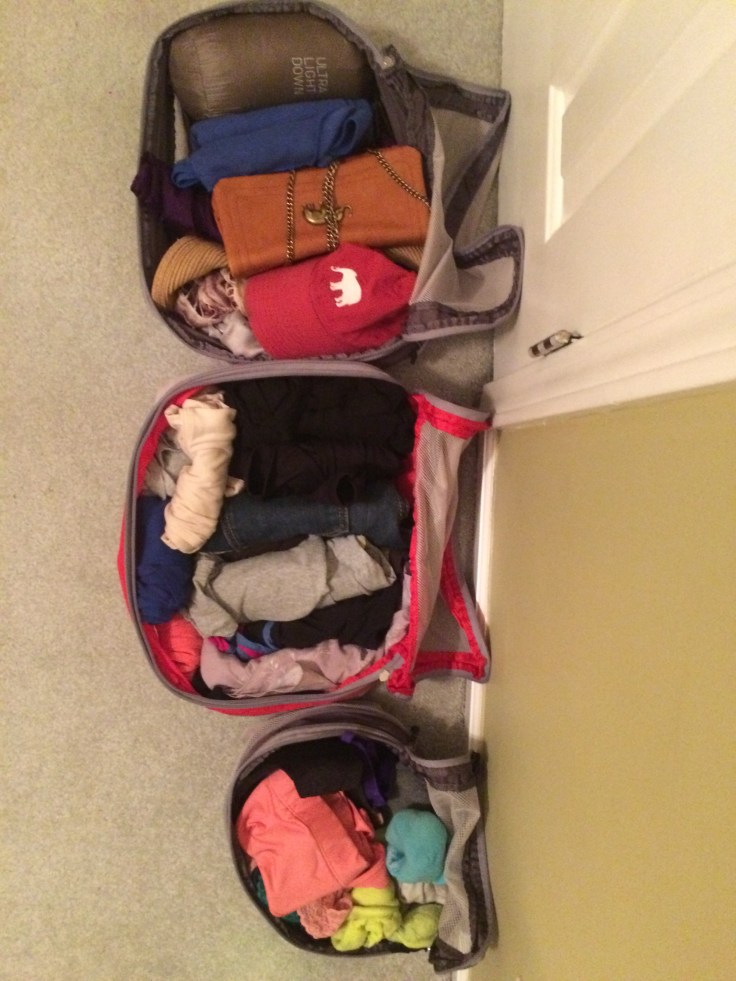
-4 packing cubes – 1 large for clothing, 1 large for accessories and outerwear, 1 small for underthings, 1 small for dirty clothes; a set of 2 are $30 at REI
Packing cubes are keeping me organized.
Shoes:
-1 pair North Face hiking “boots” – they look more like sneakers, but have added support and Goretex (which makes it waterproof and breathable) for hiking
These shoes have a lot of miles to go this summer!! 🙂
-1 pair Haviana flip flops – to wear in the shower or casually out. I chose a pair that look a little dressier than standard flip flops but are made out of the same material for only $15 at the Bloomingdale’s outlet in the UWS.
-1 pair dressier sandals – I made sure they were comfortable for walking.
*3 pairs of shoes…yes, that’s all!! Will I make it? We will see in August…
-4 tank tops, 1 dressy blouse, 1 t-shirt (Vandy, of course!), 1 long sleeve t-shirt, 1 sweater
-1 romper, 2 sundresses
Outerwear:
-1 zip-up sweatshirt/cardigan
-1 Ultra Light Down Jacket from Uniqlo- I am very excited about this purchase! This jacket squishes down into a small ball and weighs less than a pound, and is also super warm and water-resistant. I will be wearing this a lot in South America, but it is also easy to carry/pack in a purse for a chilly evening in Europe as well.
-1 rainjacket
-2 scarves
-1 straw brim hat – Another exciting purchase! This hat is also “squishable” and can be crushed into a bag without ultimately losing its shape. It also offers SPF 50 protection.
-1 baseball cap (Alabama, of course!)
-1 Buff – you can read about how much I love the Buff here.
Underthings:
-4 bras – 1 sport, 1 strapless, 2 regular
-A week’s worth of undies
-5 pairs of socks
-2 swimsuits
Accessories:
-eyeglasses and case
-small bag of assorted, non-valuable necklaces, earrings, and bracelets
-sunglasses
-hair ties and hair clip
Toiletries/Medicines:
-2 mini-bottles shampoo, 4 mini-bottles conditioner, 1 mini-bottle facewash (I am pretty particular about my shampoo, conditioner and facewash, so I filled some empty travel size bottles to last me as long as possible before I need to buy refills on the road.)
-2 razors, toothbrush and toothpaste, dry shampoo, baby powder, deodorant , retainer (lol!), contact case and solution, extra contacts
–stomach sickness medicines, vitamins, malaria tablets, Melatonin (to combat jetlag and to help with getting some rest on long flights)
-cosmetics (bronzer, mascara, lipstick, chapstick, travel-size brush, tweezers, nail file), small hairbrush, small perfume
Travel Supplies:
-flashlight
-headlamp flashlight – this proved to be so useful in Africa! I literally did not go anywhere at night without it. I may not use it as frequently this summer, but I know it will come in handy at some point.
-DEET mosquito spray – Mosquitoes don’t play, and I don’t have time to get a tropical disease!
-reusable water bottle, reusable plastic chopsticks
–quick-dry travel towel – this towel has a strange texture, but can hold 2x its weight in water and dries overnight. Needless to say it is also very compact!
–travel laundry detergent – I anticipate I will be doing a lot of handwashing of clothes on the road. This travel detergent looks like a packet of Listerine strips, yet each “strip” becomes detergent for 1 load of laundry! The packet contains 50 strips/loads.
-guidebooks for Southeast Asia and Eastern Europe, “This Please!” pointbook, 1 book for pleasure reading (I could have packed my Kindle, but decided against it for the simple reason that I want to use the hostel book exchanges. I think the idea of trading real books with paper pages with other traveling strangers is romantic and old-fashioned in the best of ways, and I want to count this as part of my adventure!)
Electronics:
–Chromebook and charger- I had originally decided to bring my regular laptop along on the trip. However, I realized that even though it was designed to be light and sleek, it was still a little too big. I purchased a Chromebook for a reasonable price that weighs 2.5 pounds and is a perfect size for travel. Plus, if it gets lost, stolen, or damaged, I won’t be devastated.
-phone and charger
-portable battery charger – This item is a lifesaver, and I already keep it in my purse for long days in NYC when my phone battery gets drained.
-headphones
-power outlet adapter – I made sure to buy a 1-piece adapter that works on all 3 continents.
-camera – I’m bringing a simple point-and-click Nikon digital camera.
-extra batteries for camera and flashlights, extra camera memory card
-memory card USB reader
Necessities:
-passport
-yellow fever certificate
-credit and debit cards, cash, and currencies
-small moleskine notebook and pen
-printed copies of reservations for flights, hostels, transportation, etc; photocopies of passport and yellow fever certificate Did I leave anything important out? Am I packing too much? I guess I will find out once I leave the U.S. tomorrow!













 Then, we started feeding the elephants bananas. Elephants eat between 200 and 300 kilograms of food per day! The elephants were not shy at all, and actually followed us when they saw we had bananas in our hands! One elephant even almost mistook my iPhone in my hand as a banana…crisis averted! These elephants were very muddy, and it didn’t take long before I was very muddy.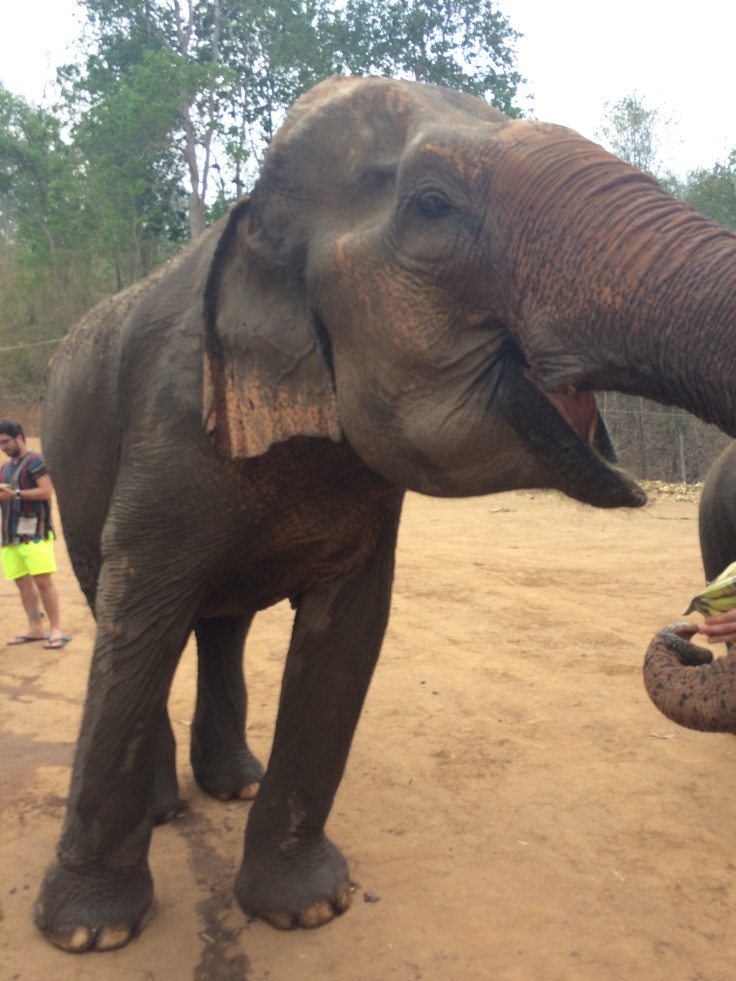






 a southern yankee abroad
Recent Comments